Use of NSAIDs,or nonsteroidal anti-inflammatory drugs,is associated with 25 per cent reduction in all-cause mortality among long-term colorectal cancer survivors

Colon Cancer Treatment: New Drug Combined With Doxorubicin Could be the Way to Go
Combining a new cancer drug along with doxorubicin shows promise in the treatment of colon cancer.
Combining a new cancer drug along with doxorubicin shows promise in the treatment of colon cancer.
‘NSAIDs such as aspirin, ibuprofen and naproxen have a particularly advantageous effect when taken after diagnosis by colorectal, or CRC, patients without tumor mutation in the KRAS gene.’





"Several other studies have shown an association between NSAIDs and preventing CRC, but this is the first to look so thoroughly at how timing of NSAID use relative to diagnosis and tumor type could make a big difference in survival," said Dr. Polly Newcomb, an epidemiologist in the Public Health Division at Fred Hutch and senior author of the study. "These results should spark conversations between patients and their doctors. NSAID use is an accepted practice to prevent cardiovascular disease, and their use as a tool against cancer merits similar consideration and study." The observational study used data from 2,419 newly diagnosed patients in the Colon Cancer Family Registry, an international consortium that collects lifestyle, family history and medical information from CRC patients from the U.S., Canada and Australia. The researchers were able to divide patients into four groups: those who took the drugs before as well as after diagnosis, those who initiated use post-diagnosis, those who quit use post-diagnosis and those who did not use them at all. The researchers also employed tumor-marker testing by genotyping patient samples to pinpoint tumor mutations and tumor type.
The study was conducted at Fred Hutch and included three other sites: the Mayo Clinic in Rochester, Minnesota; Cancer Care Ontario in Toronto, Canada; and the University of Melbourne in Melbourne, Australia, and followed patients for a median of 10.8 years after diagnosis. In the group, 42 percent regularly took some form of NSAIDs, both aspirin and non-aspirin.
Colorectal Cancer Screening
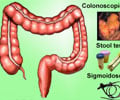
Colorectal screening is done using tests to detect blood in stool, colonoscopy or sigmoidoscopy ordouble contrast barium enema or CT colonography.
Colorectal screening is done using tests to detect blood in stool, colonoscopy or sigmoidoscopy ordouble contrast barium enema or CT colonography.
Some limitations of the study include that it relied upon patients to self-report their NSAID use and the generalizability of the study may apply only to long-term CRC survivors. The team recommends that future efforts include a more racially diverse population.
Advertisement

Two-Drug Combination Reduces Growth Of Advanced Colon Cancer Tumors By 67%
Sym004, a mixture of two antibodies that act against the epidermal growth factor receptor protein, is effective in patients with advanced colorectal cancer.
Sym004, a mixture of two antibodies that act against the epidermal growth factor receptor protein, is effective in patients with advanced colorectal cancer.
Advertisement

A Cup of Cranberry Extracts Daily can Fight Off Colon Cancer And Other Cancers
Chemicals derived from cranberry extracts could selectively kill off colon tumor cells in laboratory dishes. This is approximately equivalent to one cup a day.
Chemicals derived from cranberry extracts could selectively kill off colon tumor cells in laboratory dishes. This is approximately equivalent to one cup a day.