MEDINDIA
 English
 हिन्दी
 Español
 français
 中文
中文
Deep cuts in carbon dioxide emissions are required to prevent coral reefs around the world from dying off suggests a new study.
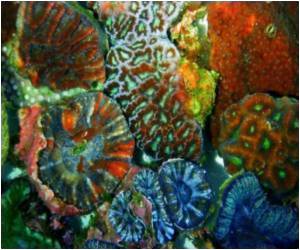

Investigating Coral Reefs to Help Understand Past and Future Climate Change
Increasing Earth temperatures and rising sea levels. Both of these are effects of climate change.
Increasing Earth temperatures and rising sea levels. Both of these are effects of climate change.
But they are very sensitive to changes in ocean chemistry resulting from greenhouse gas emissions, as well as to coastal pollution, warming waters, overdevelopment, and overfishing.
Ricke and Caldeira, along with colleagues from Institut Pierre Simon Laplace and Stanford University, focused on the acidification of open ocean water surrounding coral reefs and how it affects a reef's ability to survive.

Economic Boom in China Responsible for Shrinking of Coral Reefs in the Country
China has quickly emerged as one of the fastest growing economies in the world but the economic boom has been accompanied by disappearing coral reefs.
China has quickly emerged as one of the fastest growing economies in the world but the economic boom has been accompanied by disappearing coral reefs.
When carbon dioxide, CO2, from the atmosphere is absorbed by the ocean, it forms carbonic acid (the same thing that makes soda fizz), making the ocean more acidic and decreasing the ocean's pH.

One Third of Coral Reefs Facing Destruction
Global warming compounded by destructive fishing habits could be driving nearly a third of coral reefs across the world to destruction.
Global warming compounded by destructive fishing habits could be driving nearly a third of coral reefs across the world to destruction.
Deep cuts in emissions are necessary in order to save even a fraction of existing reefs, according to the team's results.

Climate Change can Damage Coral Reefs
A research suggested that with strong action on mitigating greenhouse-gas emissions and the assumption that corals can adapt at extremely rapid rates,two thirds of corals could be saved.
A research suggested that with strong action on mitigating greenhouse-gas emissions and the assumption that corals can adapt at extremely rapid rates,two thirds of corals could be saved.
The study is set to be published by Environmental Research Letters.
Source-ANI
 Email
Email