MEDINDIA
 English
 हिन्दी
 Español
 français
 中文
中文
Hypocretin (neuropeptide) increase may be a factor in opiate craving and raising the number of hypocretin cells to near normal levels could reverse narcoleptic symptoms.

Narcolepsy - Overview Incidence Causes Symptoms Diagnosis Treatment Prognosis Prevention FAQs
Sleep is the blissful state that rejuvenates our mind and body everyday and any deprivation often leads to a disorder that can affect our health
Sleep is the blissful state that rejuvenates our mind and body everyday and any deprivation often leads to a disorder that can affect our health
TOP INSIGHT

Hypocretin (neuropeptide) increase may be a factor in opiate craving and raising the number of hypocretin cells to near normal levels could reverse narcoleptic symptoms.
Narcolepsy affects about one in 2,000 to 3,000 people but can go undiagnosed for years, according to the National Sleep Foundation. The sleep disorder usually has its onset in childhood or adolescence.
In a new study, these researchers discovered that people addicted to heroin have, on average, 54 percent more hypocretin-producing neurons than do people without addiction. They confirmed, in mice, that opiates cause this increase. The increase in hypocretin cells lasted for as long as four weeks after discontinuation of the morphine treatment, well after morphine had left the animals' bodies.

Quiz on Narcolepsy
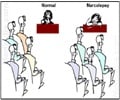
Narcolepsy is a chronic neurologic disorder that involves loss of brain's ability to regulate sleep and wake cycles normally. People having narcolepsy frequently sleep during the day as compared to those people who don't suffer from it. These sudden attacks of sleep can occur during any type of activity and at any time of the day. A normal sleep pattern involves the early stages of sleep then followed by deeper sleep stages and ultimately rapid eye movement (REM) sleep. In narcoleptic people, REM sleep occurs almost immediately in sleeping cycle and periodically during the waking hours.
Narcolepsy normally starts between ages of 15 and 25, but can become obvious at any age. In many cases, narcolepsy remains undiagnosed and hence untreated.
Narcolepsy is a chronic neurologic disorder that involves loss of brain's ability to regulate sleep and wake cycles normally. People having narcolepsy frequently sleep during the day as compared to those people who don't suffer from it. These sudden attacks of sleep can occur during any type of activity and at any time of the day. A normal sleep pattern involves the early stages of sleep then followed by deeper sleep stages and ultimately rapid eye movement (REM) sleep. In narcoleptic people, REM sleep occurs almost immediately in sleeping cycle and periodically during the waking hours.
Narcolepsy normally starts between ages of 15 and 25, but can become obvious at any age. In many cases, narcolepsy remains undiagnosed and hence untreated.

Impact of Drug Abuse on Health and Society
Drug abuse is a negative social trend that pushes youth to drug addiction in the pretext of getting psychological effects like excitation.
Drug abuse is a negative social trend that pushes youth to drug addiction in the pretext of getting psychological effects like excitation.
Source-Eurekalert

Drug Abuse Screening Test
Drug Abuse Screening Test (DAST) is a screening test to find out if you need professional help with ‘Drug Abuse’ problem. This is only an anonymous self test.
Drug Abuse Screening Test (DAST) is a screening test to find out if you need professional help with ‘Drug Abuse’ problem. This is only an anonymous self test.
 Email
Email