MEDINDIA
 English
 हिन्दी
 Español
 français
 中文
中文
A new study by UC Santa Cruz researchers suggests that a continued increase of Lyme disease in the United States.
Lyme Disease - Causes, Symptoms, Diagnosis, Treatment, Prevention
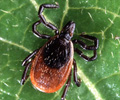
Lyme disease is acquired through the bite of a tick that is infected with the bacterium Borrelia burgdorferi.
Lyme disease is acquired through the bite of a tick that is infected with the bacterium Borrelia burgdorferi.
"A new top predator has entered the northeast and has strong impact on the ecosystem," said Taal Levi, a recent UCSC Ph.D. graduate in environmental studies. Levi is the lead author of Deer, Predators, and the Emergence of Lyme Disease, published this week online. Coyotes can and will kill foxes and more significantly, Levi said, "foxes often don't build dens when coyotes are around."
Levi and his UCSC co-authors, A. Marm Kilpatrick, assistant professor of ecology and evolutionary biology; Marc Mangel, distinguished professor in applied mathematics and statistics; and Chris Wilmers, assistant professor of environmental studies, used an extensive dataset from five states as well as mathematical models to determine why Lyme disease continues to rise despite stabilized numbers of deer, long known to act as reproductive hosts for adult ticks that carry Lyme disease bacteria.

Existence of �Chronic Lyme Disease� Questioned
There is no evidence that “chronic Lyme disease” exists and if it does, the risks of prolonged antibiotic treatment outweigh any benefits
There is no evidence that “chronic Lyme disease” exists and if it does, the risks of prolonged antibiotic treatment outweigh any benefits
"We found that where there once was an abundance of red foxes there is now an abundance of coyotes," said Levi, who has just begun a position as a researcher at the Carey Institute for Ecosystems Studies in the hotspot for Lyme disease, Duchess County, north of New York City. There he works as a postdoctoral research fellow with Lyme disease expert Rick Ostfeld, who literally wrote the book on Lyme disease, Lyme Disease Ecology of a Complex System.

Lyme Disease Cases Rising In The U.S
Health officials are sounding the alarm as cases of Lyme disease increase in regions of Massachusetts, Pennsylvania, Philadelphia and neighboring regions.
Health officials are sounding the alarm as cases of Lyme disease increase in regions of Massachusetts, Pennsylvania, Philadelphia and neighboring regions.
Lyme disease can be treated with antibiotics if discovered early, however long term patients may suffer muscle and joint pain.

Scientists Receive Patent for Development of "combination" Proteins to Produce Vaccines for Lyme Disease
UPTON -- Scientists belonging to the U.S. Department of Energy's Brookhaven National Laboratory and collaborators at Stony Brook University have been granted the U.S. Patent Number 7,179,448
UPTON -- Scientists belonging to the U.S. Department of Energy's Brookhaven National Laboratory and collaborators at Stony Brook University have been granted the U.S. Patent Number 7,179,448
 Email
Email