MEDINDIA
 English
 हिन्दी
 Español
 français
 中文
中文
Except an association with the human papillomavirus, no validated molecular profile of head and neck squamous cell carcinoma (HNSCC) has been established.
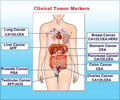
Tumor Markers - For Cancer Diagnosis and Prognosis
An ideal tumor marker for a cancer should be specific to that cancer and not generate false positive results.
An ideal tumor marker for a cancer should be specific to that cancer and not generate false positive results.
Neil Hayes, MD, MPH, associate professor of medicine and senior author, says, "Cancer is a disease caused by alteration in the DNA and RNA molecules of tumors. A cancer results when broken molecules initiate a cascade of abnormal signals that ultimately results in abnormal growth and spread of tissues that should be under tight control within the body."
"However, most common tumors, including head and neck cancer, have relatively little information in the public record as to how these signals coordinate to create different patterns of abnormalities. This study is among the largest ever published to document reproducible molecular tumor subtypes. Subtypes, such as those we describe, represent attractive models to understand and attack cancers for treatment and prognosis."
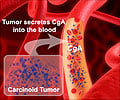
Carcinoid Tumors - Carcinoid Syndrome - Symptoms, Signs, Diagnosis & Treatment
Carcinoid tumors is a benign tumor that results in carcinoid syndrome. Only 8 to 10% of all carcinoid tumors are associated with the carcinoid syndrome.
Carcinoid tumors is a benign tumor that results in carcinoid syndrome. Only 8 to 10% of all carcinoid tumors are associated with the carcinoid syndrome.
The team, composed of investigators from UNC and five other institutions, analyzed a set of nearly 140 HNSCC samples. By searching for recurrent patterns known as gene expression signatures, they were able to detect four gene expression subtypes. The subtypes are termed basal, mesenchymal, atypical, and classical based on similarities to established gene expression subtypes in other tumor types and expression patterns of specific genes.

About Brain Tumor
Brain tumors are the abnormal growth of brain cells that may be benign or metastatic. Brain tumors account for about 2.4% of all the tumor diagnosesandare most challenging due to their critically delicate location.
Brain tumors are the abnormal growth of brain cells that may be benign or metastatic. Brain tumors account for about 2.4% of all the tumor diagnosesandare most challenging due to their critically delicate location.
 Email
Email