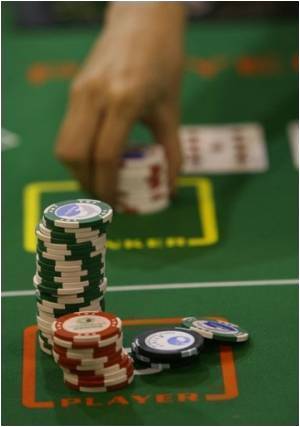
It is well-known that a lot goes on inside a gambler's mind from the moment the dice starts rolling or when the starting gates swing open at the track.

Brain Exercises to Improve Memory
An active brain can certainly help in improving memory by strengthening the connections between neural impulses in brain.
An active brain can certainly help in improving memory by strengthening the connections between neural impulses in brain.
Recently, researchers at the California Institute of Technology (Caltech) and Ireland's Trinity College Dublin proposed that a certain region of the brain drives these different types of decision-making behaviors.
"Through our study, we found a difference in activity in a region of the brain called the dorsal striatum depending on whether people were choosing according to reinforcement learning or the gambler's fallacy," said John O'Doherty, professor of psychology at Caltech and adjunct professor of psychology at Trinity College Dublin.
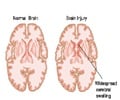
Head Injury | Brain Injury Overview Types Causes Symptoms Diagnosis Treatment
Head injury or traumatic brain injury is a leading cause of disability among children and young adults that leads to varying degrees of physical and mental stability. Fortunately, it is also one of the preventable brain disorder.
Head injury or traumatic brain injury is a leading cause of disability among children and young adults that leads to varying degrees of physical and mental stability. Fortunately, it is also one of the preventable brain disorder.
In addition, the work suggests that people who choose based on the gambler's fallacy may be doing so because at the time of the choice they are not taking into account what they had previously learned or observed.
Advertisement

Brilliant Human Brain
The most amazing and complex organ in the entire universe, the human brain continues to remain an enigma.
The most amazing and complex organ in the entire universe, the human brain continues to remain an enigma.
Source-ANI