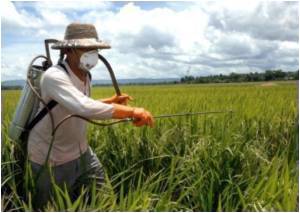
“With diminishing water reserves and increasing pesticide use, our waterways are at growing risk of contamination,” Dr David Beale of the RMIT University said. He is a PhD student in the School of Applied Sciences.
“Typical pesticide monitoring involves collecting samples on site then taking them back to a laboratory for analysis, a process that can take several days.
“By instantly identifying the presence of specific pesticide residues, this new method would enable water utilities to find out on the spot if a water catchment is contaminated.

Beware of Pesticides in Fruits and Vegetables
A recent report has revealed that most of the fruits and vegetables we consume are not safe as they are found to be contaminated with pesticides.
A recent report has revealed that most of the fruits and vegetables we consume are not safe as they are found to be contaminated with pesticides.
The method developed by Dr Beale as part of his PhD can give an on-the-spot indicative reading identifying the presence of triazines, triazinone and selected organophosphates in water samples, with confirmation performed by traditional analytical techniques in a laboratory.
Advertisement
“I hope my work could enable water utilities to catch any contamination earlier, as well as boosting the amount of testing conducted within our water catchments,” he said.
Advertisement
“For as long as I can remember, water has been an integral part of my life; my father worked as a master mariner, the family home was close to the ocean and as a teenager the ocean was my playground,” he said.
“But it was not until I started university that I started to develop a greater appreciation of water as a resource and the impact humans have on its quality.
“In my undergraduate environmental science degree I was exposed to small water quality research projects.
“During my honours year, I realised the enormity of pesticide contamination in water and my attention shifted to the investigation of pesticide residue in drinking water – a topic that I continued to research during my PhD.”
Source-Medindia