MEDINDIA
 English
 हिन्दी
 Español
 français
 中文
中文
A new machine learning model developed by researchers helps predict the risk of mortality of intensive care unit patients according to their characteristics.

Artificial Intelligence in Healthcare - An Overview
Artificial intelligence (AI) in healthcare is the discipline using data intensive computer based solutions to improve patient care and outcome.
Artificial intelligence (AI) in healthcare is the discipline using data intensive computer based solutions to improve patient care and outcome.
TOP INSIGHT

The hierarchical machine learning predictive prognosis model has a good predictive behavior, and it also allows studying which of the patient's traits are the most decisive, which can become risk factors, in assessing their risk of death.
A group of researchers led by Dr Rosario Delgado from the Department of Mathematics of the UAB, in collaboration with Head of the ICU at Hospital de Mataró Dr Juan Carlos Yébenes, UAB associate lecturer Àngel Lavado from the Information Management Unit of the Maresme Health Consortium, and José David Núñez-González, PhD student of the UAB Department of Mathematics, used machine learning tools to create a model capable of predicting the risk of mortality of ICU patients, based on a real database which also served to validate the model. The model will aid in the decision-making process of healthcare workers by improving the prediction of premature deaths, making medical decisions about high-risk patients more efficient, evaluating the effectiveness of new treatments and detecting changes in clinical practices.
The use of this model represents a clear improvement in traditional approaches, consistent with predicting the risk of mortality based on the Acute Physiology And Chronic Health Evaluation (APACHE) score - a questionnaire widely used to assess a person's state of health with the help of different indicators. The new model makes use of an estimated logistical regression that was validated in previous groups of patients. Researchers were able to demonstrate experimentally that the new model they created overcomes the weak points of traditional approaches, offering good results and presenting itself as a better alternative.

Test Your Knowledge on Artificial Intelligence
Artificial intelligence (AI) or machine intelligence refers to the intelligence displayed by computers or robots in contrast to the natural intelligence exhibited by humans. It is considered one of the major advancements of the 4th industrial revolution and finds application in several fields including medicine. Take this quiz to test your knowledge on artificial intelligence
Artificial intelligence (AI) or machine intelligence refers to the intelligence displayed by computers or robots in contrast to the natural intelligence exhibited by humans. It is considered one of the major advancements of the 4th industrial revolution and finds application in several fields including medicine. Take this quiz to test your knowledge on artificial intelligence
Researchers improved the model's prediction through a combination of individual predictions of each classifier designed in a way that the faults of some predictions could be compensated with other correct predictions, and taking into account the imbalance represented by a low proportion of patients dying in the ICUs. The model predicts the cause of death of patients at a high risk, as well as the outcome of patients at a low risk of dying. This type of model is known as a hierarchical predictive model, given that there are two stages of prediction.
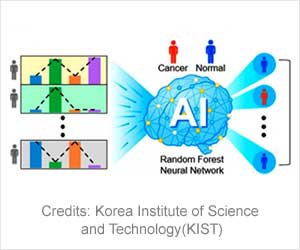
Artificial Intelligence Helps Diagnose Prostate Cancer
Smart artificial intelligence analysis method and a new electrical-signal-based ultrasensitive biosensor diagnose prostate cancer from the urine within minutes.
Smart artificial intelligence analysis method and a new electrical-signal-based ultrasensitive biosensor diagnose prostate cancer from the urine within minutes.
Source-Eurekalert

Artificial Intelligence-Enhanced ECG for Rapid Heart Failure Assessment
Artificial Intelligence-Enhanced ECGs are quicker at assessing high-risk cardiac patients and outperform current standard-of-care blood tests, reveals a new study.
Artificial Intelligence-Enhanced ECGs are quicker at assessing high-risk cardiac patients and outperform current standard-of-care blood tests, reveals a new study.
 Email
Email