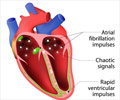
Results from a large, international, randomised, controlled trial have shown that there is a strong link between diabetics who have an abnormal heart rhythm (atrial fibrillation) and an increased risk of other heart-related problems and death. The findings are published in Europe's leading cardiology journal, the European Heart Journal [1] today (Thursday 12 March).
The ADVANCE [2] study of 11,140 patients with type 2 diabetes found that patients who had atrial fibrillation (AF) at the start of the trial had a 61% increased risk of dying from any cause, a 77% increased risk of dying from cardiovascular causes such as a heart attack or stroke, and a 68% increased risk of developing heart failure or other cerebrovascular problems such as stroke, when compared with diabetic patients who did not have AF.However, the study also found that if clinicians gave more aggressive treatments to the diabetic AF patients – in this study they treated them with a combination blood pressure lowering drugs, (perindopril and indapamide) – the risk of dying or developing any of these complications was reduced. It was also reduced in diabetic patients without AF who were given the same treatment.
Professor Anushka Patel, Director of the Cardiovascular Division at The George Institute for International Health (University of Sydney, Australia) and an Associate Professor in the Faculty of Medicine at the university, who led the study, said: "Active treatment produced similar relative benefits to patients with and without AF. However, because of their higher risk at the start of the study, the absolute benefit associated with active treatment was greater in patients with AF than without. We estimate that five years of active treatment would prevent one death among every 42 patients with AF and one death among every 120 patients without AF."
The findings have important implications for the management of diabetics and for policy in this area. Diabetes is a major global health problem, with an estimated worldwide prevalence of 2.8% in 2000, projected to increase to 4.4% in 2030. Atrial fibrillation is common in diabetic patients.

Diabetes Risk Assessment Calculator
Almost one-third of the people are unaware of the risk factors of diabetes. Find out if you run the risk of diabetes by using Diabetes Risk Assessment calculator.
Almost one-third of the people are unaware of the risk factors of diabetes. Find out if you run the risk of diabetes by using Diabetes Risk Assessment calculator.
"The number of diabetic patients is projected to increase to 380 million at 2025. We might expect that about 40 million of these will also have AF. Thus the study findings have direct implications for a large number of individuals globally.
Advertisement

Atrial and Junctional Arrhythmias
Arrhythmias that originate in the atrium are called atrial arrhythmias.
Arrhythmias that originate in the atrium are called atrial arrhythmias.
"An example of this comes from the results of the blood pressure intervention in ADVANCE. Routine administration of a fixed combination of perindopril and indapamide to patients with type 2 diabetes resulted in 18% reduction of cardiovascular death and 14% reduction of death from any cause in both patients with and without AF. However, because of their higher baseline risks, patients with AF benefited more, in absolute terms."
Advertisement

Sleep-wake Rhythm Implicated in Diabetes
An international team of researchers has identified a genetic variant associated with increased fasting glucose levels and a high risk for type 2 diabetes.
An international team of researchers has identified a genetic variant associated with increased fasting glucose levels and a high risk for type 2 diabetes.
Prof Patel pointed out that AF was frequently undetected in diabetic patients. "The current analysis highlights the importance of actively evaluating diabetic patients for the presence of AF, to identify those at particularly high risk of cardiovascular events. Routine administration of blood pressure-lowering treatment, as well as greater use of antiplatelet or anticoagulant agents and statins, may be expected to reduce the incidence of a broad range of adverse outcomes in these patients."
Source-Eurekalert
SRM