Diet, Nutrition and Supplements for Osteo-Arthritis and Rheumatoid Arthritis
Rheumatoid arthritis patients should consume a diet rich in natural antioxidant and anti-inflammatory nutrients and avoid foods like sugar, saturated fats, and trans fatty acids.
Rheumatoid arthritis patients should consume a diet rich in natural antioxidant and anti-inflammatory nutrients and avoid foods like sugar, saturated fats, and trans fatty acids.
‘Early and aggressive treatment of Rheumatoid Arthritis with biologic drugs may be most effective in halting progressive bone loss in patients with Rheumatoid Arthritis.’
Tweet it Now
A new review by the International Osteoporosis Foundation (IOF)
Chronic Inflammation and Bone Structure (CIBS) Working Group concludes
that early and aggressive treatment of Rheumatoid Arthritis with
biologic drugs, specifically biological disease-modifying anti-rheumatic
drugs (DMARDs), may be most effective in halting progressive bone loss
in patients with RA. Co-Author Dr. Cristiano Zerbini, Director of the Centro Paulista de Investigação Clinica (CEPIC) in Sao Paolo, Brazil, stated, "Bone loss is one of the most harmful effects induced by chronic inflammation as well as by medications taken to treat rheumatoid arthritis, such as glucocorticoids. It is therefore important that we gain a better understanding of which medications used to treat patients with chronic inflammation are less likely to impact negatively on bone health."
One study has shown that continuous treatment with prednisone at 10 mg/day during 90 days or more increased the risk of vertebral fractures 17-fold and hip fractures seven-fold.

Rheumatoid Arthritis - Causes, Symptoms, Diagnosis, Treatment, FAQs
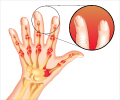
Rheumatoid arthritis is a chronic inflammatory disease that causes pain, swelling, stiffness and loss of function in the joints.
Rheumatoid arthritis is a chronic inflammatory disease that causes pain, swelling, stiffness and loss of function in the joints.
The Working Group concluded that:
Advertisement

Tests for Rheumatoid Arthritis
Are you experiencing pain in the joints? You might have Rheumatoid arthritis, a condition affecting joints and results in pain and joint deformities. It is diagnosed by radiology and blood tests.
Are you experiencing pain in the joints? You might have Rheumatoid arthritis, a condition affecting joints and results in pain and joint deformities. It is diagnosed by radiology and blood tests.
- Therapies targeting specific cytokines and its signaling pathways with biologic DMARDs may protect the skeleton and should be introduced as soon as possible. However, it should be noted that outcomes in these clinical studies were based mostly on changes in biological markers and only a few reported modifications on BMD or localized osteoporosis. Only three retrospective studies reported reduction in fracture risk after anti-TNF therapy.
Advertisement

Physiotherapy for Arthritis
Physiotherapy enables patients with debilitating disease to regain loss of function in their muscles, and joints. Physiotherapy for rheumatoid arthritis involves electrostimulation and hydrotherapy.
Physiotherapy enables patients with debilitating disease to regain loss of function in their muscles, and joints. Physiotherapy for rheumatoid arthritis involves electrostimulation and hydrotherapy.
- Lack of efficacy of TNF blockade on hand bone loss was found, despite its preservation of BMD in lumbar spine and hip. Better results regarding localized bone loss were observed with anti-IL6 treatment.
- Very few studies reported inhibition of bone loss after rituximab and abatacept treatment.
- Anti-RANKL therapy showed beneficial effects in the preservation of bone mass in RA, especially in juxta-articular osteoporosis, although this treatment cannot alter the inflammatory process.
- New non-biologic therapies but potent inhibitors of the cytokine network may offer future options for skeleton preservation in RA.
Professor Patricia Clark, Co-author, Head of Clinical Epidemiology, Hospital Infantil de Mexico, Mexico City, stated, "Although several studies reported favourable actions of biologic therapies on bone protection, it is clear that there are still unmet needs for research into their actions on the risk of bone fractures in RA patients. In the meantime, we recommend that all physicians treating RA remain vigilant of the high risk of bone loss and fractures in their patients. For many such high risk patients, it is important that osteoporosis treatment be considered to reduce fracture risk."
Source-Eurekalert