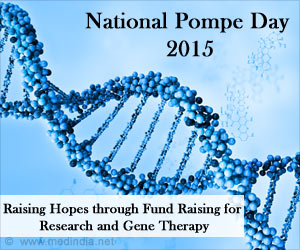
National Pompe Day 1 June 2015: Raising Hopes Through Fund Raising for Research and Gene Therapy
Pompe is a rare, genetically inherited and often fatal lysosomal storage disorder caused by the deficiency of an enzyme, acid alpha-glucosidase.
Pompe is a rare, genetically inherited and often fatal lysosomal storage disorder caused by the deficiency of an enzyme, acid alpha-glucosidase.
‘Major flaws have been observed with a large number of research papers in biomedical sciences. This problem reportedly wastes billions and slows the pace of life-saving research.’
Tweet it Now
"We hope our survey will further sensitize scientists, funders, journals and other science-related stakeholders about the need to improve these indicators," wrote the study authors, who included prominent scientist John Ioannidis from the Meta-Research Innovation Center at Stanford University and Shareen Iqbal from Emory University. A separate study by researchers in Germany examined hundreds of published experiments on stroke and cancer research and found that most did not contain sufficient information about how many animals were used.
In many papers, the number of animals used over the course of the study 'vanished', making any conclusions far less reliable.

Research Agenda to Improve Hospitalized Care for Geriatric Patients
A new research agenda may help improve hospital care in older patients with acute illness.
A new research agenda may help improve hospital care in older patients with acute illness.
When human subjects are part of a clinical trial, information about how many took part is considered crucial to the findings, and would not be left out of the published study, the authors said.
Advertisement

International Clinical Trials Day 2015
International Clinical Trials Day is marked on May 20 every year to commemorate the first clinical trial by Dr.James Lind.
International Clinical Trials Day is marked on May 20 every year to commemorate the first clinical trial by Dr.James Lind.
For instance, a recent attempt to replicate 100 psychology studies found that only 39% could in fact be reproduced.
Advertisement

Science Behind the Placebo Effect
The placebo effect explains how truly miraculous the human mind is. Read on to find out how it actually works.
The placebo effect explains how truly miraculous the human mind is. Read on to find out how it actually works.
Source-AFP