
Autism Causes, Symptoms, Diagnosis, Treatment, Prognosis
Autism is a neurodevelopmental disorder typically characterized by impaired social and communication skills combined with repetitive movements.
Autism is a neurodevelopmental disorder typically characterized by impaired social and communication skills combined with repetitive movements.
‘Proactive control is a very important cognitive function that allows you to plan and prepare how to direct your attention.
’
Tweet it Now
"Proactive control allows you to follow directions or achieve certain goals without getting distracted," said Marie Krug, an assistant project scientist in the Solomon Lab at the UC Davis MIND Institute and lead author of the study.Autism, depression symptoms, and cognitive control
In this study, published May 14 in the Journal of Abnormal Psychology, the researchers examined whether proactive control is different in adolescents and young adults with ASD than in individuals with typical development. They also studied how repetitive behaviors (a symptom of ASD) and psychological disorders (such as depression, anxiety, and attention-deficit/hyperactivity disorder) are related to proactive control.
Top 15 Toxic Chemicals Affecting Brain Development In Children
Toxic chemicals found in the environment in the air, water, soil and even in day to day stuff we use can cause irreversible brain damage in infants and children. Learn more about toxic exposures and how to protect your child.
Toxic chemicals found in the environment in the air, water, soil and even in day to day stuff we use can cause irreversible brain damage in infants and children. Learn more about toxic exposures and how to protect your child.
The researchers assessed proactive control using a picture-word Stroop test. They asked participants to name animals depicted in drawings with a superimposed word. They calculated "interference effects" by measuring the difference in the participants' reaction time between difficult incongruent trials (with nonmatching animal pictures and words) and simpler congruent trials (with matching animal pictures and words). They used two versions of the Stroop task: a mostly congruent block and a mostly incongruent block.
Advertisement

AI Algorithm Used to Find Causes of Autism Linked to Our �Junk� DNA
Using Artificial Intelligence (AI), a team of researchers has shown that mutations in ‘junk’ DNA can cause autism. Junk DNA mutations affect the expression of genes in the brain including those genes directly responsible for neurodevelopment and neuron migration.
Using Artificial Intelligence (AI), a team of researchers has shown that mutations in ‘junk’ DNA can cause autism. Junk DNA mutations affect the expression of genes in the brain including those genes directly responsible for neurodevelopment and neuron migration.
The study did not find any association between proactive control and repetitive behaviors, anxiety, or attention-deficit/hyperactivity problems in the ASD group. Participants with autism who had more symptoms of depression showed less ability to implement proactive control.
Advertisement
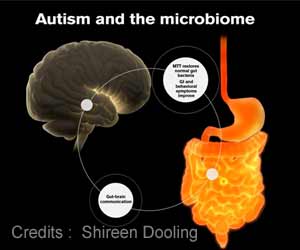
Fecal Transplants Help Reduce Autism Symptoms by Half
Fecal transplants could be used to treat children diagnosed with Autism Spectrum Disorder (ASD). Microbiota Transfer Therapy (MTT), a type of fecal transplant is effective in improving gut health and autism symptoms in children.
Fecal transplants could be used to treat children diagnosed with Autism Spectrum Disorder (ASD). Microbiota Transfer Therapy (MTT), a type of fecal transplant is effective in improving gut health and autism symptoms in children.
"This study helps us better understand the cognitive strengths and challenges in persons with autism," said Marjorie Solomon, professor of psychiatry and behavioral sciences at UC Davis and senior author of the study. "It also provides clues on the impact of co-existing conditions such as depression on these persons with autism, and thereby aids researchers with treatment development."
Source-Eurekalert