About
A person with testicular cancer may have a testicle that is three times its original size. The greatest risk factor is undescended testes. Testicular cancer has an amazing cure rate, if detected early.
Testicular cancer is a type of cancer that affects the testicles (or testes) which are the sperm-producing part of the male reproductive system.
The testes, in the human male, are two in number and are located just below the penis, in a pouch–like structure, called the scrotum. They are responsible for storing the male gametes - sperms, and also play an active role in the production of the male hormone, called testosterone.
The vast majority of testicular cancers are Germ Cell Tumors, which comprises of two subtypes-Seminomas and Teratomas. Younger patients have a greater chance of developing seminomas while the older men are inclined to develop teratomas.
Unlike other cancers, the chances of developing testicular cancer does not increase with age. It occurs mostly in men who are between 25-45 years of age. The occurrence pattern follows three peaks in a male's lifetime:
- Infancy
- 25-40 years
- After 60 years
In younger men, germ cell tumors of the testes are the most common.
Testicular cancer occurs more commonly in white males and is rare in men of Asian or African origin, although the frequency in the latter is on the increase. Scandinavia, Germany, and New Zealand report the highest incidence. They account for 1% of all malignant tumors.
No environmental agent has been conclusively implicated in the development of testicular cancer. Undescended testes (Cryptorchidism), a congenital defect, is the most common risk factor. It increases the risk by 14 to 48 times the normal expected incidence.
A pain-free testicular mass is the most common presenting symptom. A person with the cancer may have a testicle that is three times the original size. Concurrently this may lead to a shrinking in the size of the other testicle as the tumor ‘feeds’ on the scrotal blood supply.
Not all the testicular lumps are tumors; many other conditions, such as a tense hydrocele, hematocele, epididymitis, and varicocele are capable of mimicking testicular cancer. In 25% of the patients the diagnosis of the tumor is missed leading to a delay in treatment.
Testicular cancer has an amazing cure rate, especially if detected early. This has been made possible by improvements in the adjuvant (preventive) therapy which comprises of a combination of chemotherapy, radiation and careful watching after a surgery. Doctors recommend regular self-examination for early detection.
A person who has testicular cancer is at risk of developing secondary cancers such as germ cell tumors in the contra lateral testis, leukemias, GI malignancies, melanoma, soft-tissue sarcoma, and genitourinary cancers.
Testicular Cancer Facts:
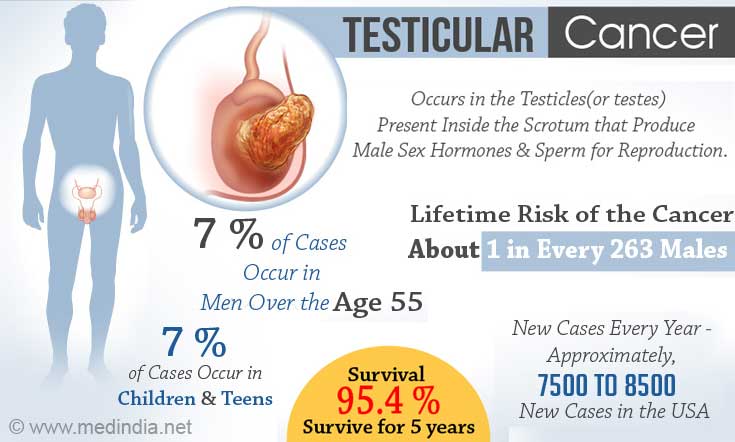
- Testicular Cancer is a rare form of cancer. A person’s risk of developing the cancer is about 0.4%
- It is more common among Caucasian males in comparison to men of African or Asian descent.
- Approximately 7,500- 8,000 diagnoses of testicular cancer takes place in the United States each year.
- This cancer mostly affects men between the ages of 20 and 35, especially those in their prime of youth, when they are most fertile.
- Testicular cancer can boast of a 90% cure rate. The cure rate is 100%, if it has not spread throughout the body (metastasized). This is one of the highest cure rates of all cancers.