Medindia » Consumer Health » Health Information » Sickle Cell Anemia - Inheritance / Causes

Sickle cell anemia–Causes-Symptoms-Diagnosis-Treatment–Prognosis

Rating : 4.05 /5 Comments : 1
Rate this Article:

Inheritance / Causes of Sickle Cell Anemia

RSS Feeds   Text 
Sickle cell anemia (SCA) patients inherit two copies of the abnormal gene, one from each of their parents and hence it is known as a genetic or hereditary disease. The disease is passed on to the affected individual in an autosomal recessive mode of inheritance.

Those with the abnormal sickle cell gene produce abnormal hemoglobin which causes sickling of the RBCs.

If a person inherits a normal gene and a sickle cell gene from each parent, they are “carriers” of SCA. They have a condition called sickle cell trait, which is inherited in an autosomal dominant fashion. 8% of the African Americans have this condition at birth while in certain parts of Africa the prevalence is 5%. There are over 2 million Americans with sickle cell trait.

Sickle Cell Anemia - Causes

The carriers of sickle cell gene or sickle cell trait (heterozygote) do not manifest symptoms of SCA, and are able to lead normal lives. However, they are capable of passing on the deleterious genes to their children.

AA – Normal progeny has two copies of the normal gene A

AS – Carrier with one normal gene A and one abnormal S gene

SA – Carrier with one normal gene A and one abnormal S gene

SS – SCA-affected progeny with two copies of abnormal S gene

The chance of getting Sickle Cell Anemia depends on the pattern of inheritance and the genotypes of the parents as described above.

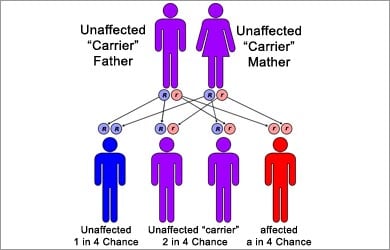
If Both parents have sickle cell trait - i.e. each has one normal hemoglobin gene and one sickle cell gene, the child has-

50% chance of inheriting sickle cell trait (one normal gene, one sickle cell gene),

25% chance of inheriting sickle cell disease (two sickle cell genes)

25% chance of not inheriting either the trait or the disease (two normal genes).

If one parent has sickle cell trait i.e. one normal gene and one sickle cell gene and the other parent is normal i.e. has no such genes, the risks are as follows-

50% chance of inheriting sickle cell trait.

50% Chance of being normal i.e. two normal genes with no risk of inheriting sickle cell disease or trait.

If one parent has sickle cell disease i.e. two sickle cell genes and the other parent has sickle cell trait i.e. one normal gene and one sickle cell gene, the child’s risks are as follows-

50% chance of inheriting sickle cell trait.

50% chance of inheriting sickle cell disease.

If one parent has sickle cell disease and the other parent has two normal hemoglobin genes, the risks are as follows-

100% chance of inheriting sickle cell trait,

No chance of inheriting the disease

If both parents have sickle cell disease-

100% chance of inheriting the disease.
Advertisement

EmailEmail RSS FeedsRSS Feeds Print this pagePrint Save this pageSave LinkLink SyndicateSyndicate
Share it!

Related Links

Stroke - Top Ten Facts


Stroke is the third most common cause of death and the most prominent cause of physical deformity in the ...

Anemia


Anemia is a condition in which the red blood cell count or hemoglobin is less than ...

Birth Defect - Genetic


Achondroplasia is a genetic disorder which is one of the leading causes of dwarfism ...

Amniocentesis


It is the simple medical procedure done during pregnancy for obtaining samples of the amniotic fluid to test for genetic ...

Amniocentesis - Animation


Amniocentesis is a procedure done after 15th week of pregnancy to obtain samples of the amniotic fluid to test for genetic disorders. A simple ...

Genetic Testing of Diseases


Genetic testing helps to confirm a genetic condition in an individual and involves q complex laboratory ...

Genetic Counseling


Encyclopedia section of medindia gives general info about Genetic counseling ...

Priapism


Priapism is persistent painful erection that lasts for more than four hours and is unrelated to sexual ...

Stroke


Stroke can cause permanent disability and it is important to recognize its early warning signs to stop its ...
Comment & Contribute
Comments should be on the topic and should not be abusive. Comments are normally moderated and are reviewed after they are posted.
* Your comment can be maximum of 2500 characters

Notify me when reply is posted
I agree to the terms and conditions
  
If you have a question about health related issues, you can now post it in our Ask An Expert section on our community website Medwonders.com and get answers from our panel of experts.
Posted by:  saisrika(Guest)  Posted on: 01/27/2013
but how to save of patient why i am asking you my doctor name of sai srika age of 10 months she blood report is sickle cell 67.7%


X
Citing this Health Article
The information on Medindia is factual, unbiased and authentic. If you find the content useful - PLEASE INCLUDE A LINK TO THIS PAGE.

Highlight the text, right-click, and select “copy”. Paste the link into your website, email, or any other HTML document.

Latest News/Research of Sickle Cell Anemia
 Delhi Children to be Checked for Anaemia
 Over 56 Percent Young Indian Girls, 30 Percent Indian Boys Anemic
 Anemia Drug Does Not Improve Health of Anemic Heart Failure Patients
 Himachal Pradesh Launches New Programme to Combat Anaemia
 High Risk of Death for Children on Dialysis Who Have Anemia
 Misdiagnosis of Genetic Disorder Leads to Unnecessary Removal of Kidneys
 Blood Transfusions Raises Death Risk in Heart Attack Patients With Anemia
 Amgen Fined $762 Million Over Anemia Drug
 Genetic Disorder In Children Linked To Poor Adaptive Behavior
 Rare Genetic Disorder Points to Molecular Pathway Linked to Schizophrenia
Total News Item 125