- Three Main Categories of Phobias - (http://www.healthguidance.org/entry/13976/1/three-main-categories-of-phobias.html)
- Social anxiety disorder (social phobia) - (http://www.mayoclinic.org/diseases-conditions/social-anxiety-disorder/basics/definition/con-20032524)
- Phobia - (https://en.wikipedia.org/wiki/phobia)
- Social anxiety disorder - (https://en.wikipedia.org/wiki/social_anxiety_disorder)
- Phobias and Irrational Fears - (http://www.helpguide.org/articles/anxiety/phobias-and-fears.htm)
- Help with Social Anxiety and Social Phobia - (http://www.helpguide.org/articles/anxiety/social-anxiety-disorder-and-social-phobia.htm)
What is Phobia?
A phobia is an irrational and exaggerated fear of an object or a situation that poses little or no actual danger in reality. Simple fears become phobias when a person goes to extreme lengths to avoid the distressing object or situation.
Phobias, classified under anxiety disorders are not due to a malfunction of the brain and can be effectively treated. People driven by a sense of fear begin to restrict their lives in order to avoid a frightening situation.

Phobias seem like irrational fears, but most people have a reason associated with their fears. People of all ages and from all walks of life across the world can develop phobic reactions.
People display certain typical emotional and physical reactions to objects and situations they dread. The fear may be so extreme that they may not be able to perform normal tasks and may even become totally paralyzed and immobile.
Childhood fears are common. If left unchecked they may develop into phobias later in life. Children as young as 5 years may develop phobias and may experience nightmares. Such phobias are more related to natural phenomenon such as lightning or thunder. Parents and other responsible adults in charge of a child need to address the situation and help the child overcome its fears before they grow out of proportion and haunt the child for the rest of its life.
During transitional times in their lives, children show signs of fear. Going back to school to a new class after a break can trigger signs of fear and anxiety in children. With proper guidance from parents and teachers these fears usually go away after a routine sets in. However if the child continues to live in fear especially as a victim of bullying in school, the fear persists even during adult life.
Social phobias are more likely to develop in schools and colleges. Phobias result in an irrational and instant response that creates anxiety when exposed to the object of fear. It is not unusual for a person to take extreme steps to avoid the object or situation that causes fear.
Interesting Facts on Phobias
There are 530 officially recognized phobias.
The National Institute of Mental Health estimates that about 19.2 million American adults or 8.7% of people suffer from one or more specific phobias.
The fear of spiders (arachnophobia) is the most common phobia in the world - 50% of women and 10% of men fear spiders.
Women’s chances of suffering from phobias are double compared with men.
A woman’s worst phobia is the fear of snakes while a man fears being buried alive.
Advertisement
Some of the strangest phobias are phobophobia (fear of having a phobia), clinophobia (fear of going to bed or sleeping), chromophobia (fear of colors), arachibutyrophobia (fear of butter sticking to the roof of the mouth) and hexakosioihexekontahexaphobia (fear of the number 666).
Last but not the least, something very relevant in today’s life is nomophobia (no mobile) - the fear of leaving our phone at home.
What are the Types of Phobias?
1. Simple or Specific Phobias
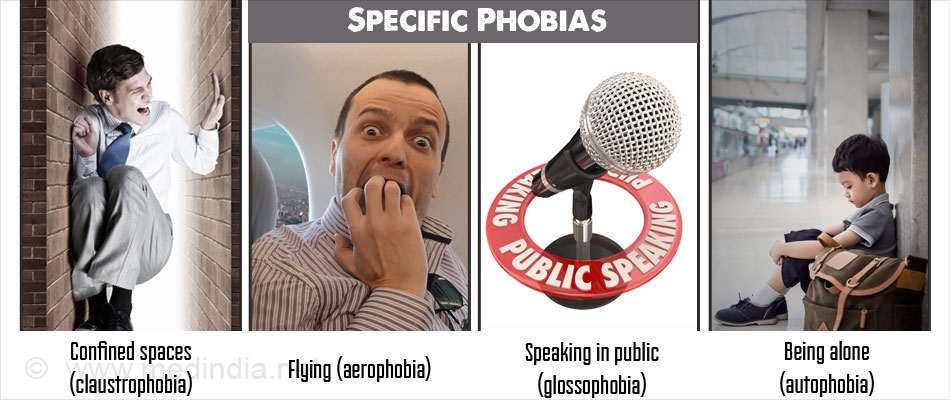
People sometimes recoil in horror from a specific object, situation or activity. Mild anxiety, panic attacks while facing the source of fear and an overwhelming need to avoid the object or situation, are some of the extreme reactions associated with specific phobias. Examples of some fears are:
- Confined spaces (claustrophobia)
- Heights (acrophobia)
- Water (hydrophobia/aquaphobia)
- Fire (pyrophobia)
- Flying (aerophobia)
- Men (androphobia)
- Speaking in public (glossophobia)
- Crowds (enochlophobia)
- Streets or crossing the street (agyrophobia)
- Thunder and lightning (astrapophobia/keraunophobia)
- Being alone (autophobia)
2. Complex Phobias
Complex phobias always involve several anxieties that can paralyze a person’s day-to-day activities. In general, they are more disabling than simple phobias, and cause more disruption in a person’s life compared to simple phobias. They often begin in adulthood and involve a deep rooted anxiety or fear of any particular situation or event.
Examples of complex phobias include:
- Social Phobia (or Social anxiety) is the second commonest phobia and comes from fear of being evaluated negatively in social situations. They have a morbid fear of embarrassing themselves or losing face in public and feel extremely vulnerable while appearing at social events. Typical signs of social phobia are reluctance to meet people at social functions, avoiding parties and restaurants and in extreme cases, cannot even muster enough courage to leave their home.
- Agoraphobia is a type of complex phobia that triggers many anxieties in a person that include fear of open, public spaces, especially crowded places like market places, shops, trains or buses. Such a person suffers from an anxiety disorder that forces the person to escape to a familiar, safe place such as home.

- Paruresis, known otherwise as ‘bashful bladder syndrome’, is a type of social phobia. People suffering from this phobia cannot bring themselves to use public toilets especially when others are nearby. This type of a reservation can interfere with day-to-day routine and hamper normal activities, such as going to a workplace, attending social events or going on holidays.
Complex phobias can cause emotional trauma and lead to self-replicating cycles - a phobia can make you behave oddly in public and later reinforce your fear of odd behavior in public. Likewise, prolonged agoraphobia can convince you of your inability to control panic attacks thus worsening the phobic condition.
Advertisement
What are the Causes and Risk Factors for Developing Phobia?
Phobias could have an evolutionary significance and they may be inherited. Extensive ongoing researches are exploring complex causes of social phobia and agoraphobia. In most types of phobias, it is believed that there may be a combination of family history, genetics, and brain chemistry, together with life situations that cause phobias and panic attacks.
- Family - Specific phobias such as fear of spiders, insects, cockroaches and lizards could run in the family. Children could inherit a phobia naturally or by observing a family member’s phobic reaction to it. Children imitate the fears of an adult member of the family that becomes a matter of habit in course of time.
- Genetics - Research team have found some genetic anomalies in people suffering from phobias. However the specific gene that causes phobias has not been isolated yet.
- Trigger - Many phobias like pyrophobia (fear of fire) could arise due to experiencing or learning about a traumatic event at a very early age. This would then remain in their mind as a negative experience.
- Brain Chemistry - It has emerged from studies that those suffering from phobias manifest a problem of serotonin-level regulation in their brains.
Amygdala is a structure in the brain that controls the fear response. An overactive amygdala can cause anxiety in social situations.
The other risk factors associated with phobias are:
- Age - Phobias mostly develop during teenage years and early adolescence.
- Personality / Temperament - Phobias could have more impact on a person who is in general more sensitive or more pessimistic in life.
- Gender- A 2006 report from Harvard Medical School titled “Coping with Anxiety and Phobia” suggests that gender appears to play a role in some types of anxiety disorders. The study explores hormonal and biological factors and differential experiences that could account for the disparities.
Advertisement
What are the Symptoms of Phobias?
If faced with the object of fear, people experience panic and have the following symptoms:
- Tachycardia or rapid heartbeat
- Sweating
- Shortness of breath
- Tingling sensation in the hands
- Nausea
- Desire to run away
- Depression, in some cases
- Trembling

How are Phobias Diagnosed?
Diagnosing a phobia is done best by a trained mental health professional. While diagnosing a phobia, mental health professionals should use clinical skills and judgment to decide whether the phobic symptoms are better explained by another disorder (such as paranoia, obsessive compulsive disorder, schizophrenia) and rule them out.
Phobias are diagnosed as fears that adult patients recognize as irrational. In generalized anxiety disorders the anxiety is more broad based. Doctors rely on the patient’s account of their phobic experiences.
General Diagnostic Criteria for Phobias
Barring some overlaps, each type of phobia has its specific set of diagnostic criteria. Diagnostic criteria common to all phobias are:
- Life Limiting - A phobia is always diagnosed only when it seriously disturbs the sufferer’s life in some way.
- Avoidance - Trying to avoid the feared object or situation is an important criterion for diagnosing a phobia. However there are some people who endure a feared situation in spite of having clinically diagnosable phobia.
- Anticipating Anxiety - People with phobias are terrified that the dreaded object or situation is lurking at every corner waiting to terrorize them.
- Panic Attack - Exposure to the dreaded object or situation triggers a sudden anxious response or panic attack in the patient.
What is the Treatment for Phobias?
Phobias can have a serious impact on a person's lifestyle, due to the distress and symptoms suffered.
1. Specific Phobias:
People with specific phobias can be treated through basic counseling, psychotherapy and maybe medicines.
- Counseling has many approaches that usually involve weekly sessions with a counselor who helps the person deal with specific problems related to the phobia. Counseling works well in treating simple phobias.
- Psychotherapy is an in-depth treatment of the phobia often focusing on locating and dealing with the root cause and identifying ways for the affected person to cope with the fear.

- A graded exposure called desensitization or exposure therapy is usually recommended for confronting the feared object or situation while having a grip on the level of anxiety.
- Cognitive behavioral therapy (CBT) explores thoughts, feelings and associated behaviors, combined with practical ways to help a person overcome the phobia. CBT has two components in the treatment process. First component involves confronting the object or situation that causes distress. Next comes dealing with any frightening thoughts and behavior associated with the anxiety.
- Drugs used to treat specific phobias are only given initially or for a short duration.
- Beta blockers block the anxiety that is associated with increased heart rate, high blood pressure and shaking by blocking the stimulatory effects of adrenaline.
- Sedatives like benzodiazepines relieve anxiety by helping us to relax.
2. Social Phobias:
Psychiatrists sometimes find it necessary to treat social phobia with a combination of cognitive behavior therapy, antidepressants, benzodiazepines and beta-blockers. Medicines are used only for a short time and always alongside behavioral therapy. Scientists have recently zeroed in on oxytocin hormone treatment for those suffering from social phobia.
What are the Complications Arising Due to Phobias?
People with specific phobias could also have:
- Academic or professional problems due to social isolation from places and things
- Mood disorders like depression and anxiety
- Drugs or alcohol issues
- Suicidal tendencies.

Tips to Deal with Phobias
- Sharing the fear with friends and family is a vital step in the healing process.
Interacting with support groups can make coping easier. - Relaxation methods such as yoga, deep breathing and progressive muscle relaxation may help with stress and anxiety.
- Mindfulness techniques help to cope with anxiety and avoidance behaviors.
- Exercises can help deal with certain fears.
- Read and hear first-person accounts of how others struggled with a phobia and beat it eventually.
- Seek a therapist if symptoms persist.