Medindia » Consumer Health » Health Information » Pancreatitis - Anatomy and Physiology of the Pancreas

Pancreatitis

Rating : 4.04 /5 Comments : 7
Rate this Article:

Anatomy and Physiology of the Pancreas

RSS Feeds   Text 
Pancreatitis is an inflammation of the pancreas. It may occur suddenly, in a severe form as in acute pancreatitis, or may continue as a slow, long drawn illness as in chronic pancreatitis.

Anatomy and function of the Pancreas

Anatomy of Pancreas

Anatomy - Pancreas is an organ situated in the upper part of one’s abdomen. It is about 6 inches or 15 cms long and has a flattened bulbous head that is surrounded by part of the intestine called duodenum, a narrow body  that lies behind the stomach and  a tapered tail that rests on the front of the left kidney (see picture).
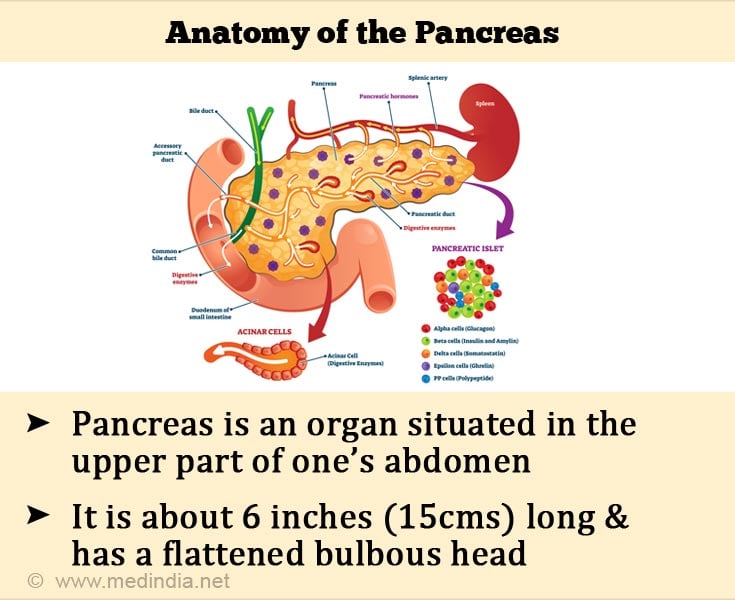
Physiology or Function-  Pancreas is one of the organs in the body that has both exocrine and endocrinal functions.

Exocrine Function - It secretes an alkaline juice with enzymes such as - amylase and lipase, which help digest the fat, protein as well as carbohydrates from the food that we eat. The alkaline juice and helps to neutralize the acid secretions of the stomach. It secretes about 1.5 liters of these juices in a day.

The enzymes are conveyed to the upper part of the small intestine called duodenum via a tube called the pancreatic duct.

Endocrine Function - It also secretes two important hormones namely - Insulin and Glucagon which are essential for regulation of glucose in the blood.

During an attack of pancreatitis, the juices are activated within the pancreatic gland and it begin to digest the pancreas itself causing inflammation, injury and necrosis resulting in an acutely inflammatory process that results in pancreatitis – so called pancreatic auto digestion. Where pancreas succumbs to its own digestive properties.
Advertisement

EmailEmail RSS FeedsRSS Feeds Print this pagePrint Save this pageSave LinkLink SyndicateSyndicate
Share it!

Related Links

Quiz on How much do You Know About Infants


The first year after the baby's birth is enjoyable as the baby is learning new things everyday. Take this quiz on the baby's first year after birth ...

Pancreatic Cancer


The pancreas is a glandular organ that lies in the abdominal cavity. It contains exocrine and endocrine glands. Pancreatic cancer is cancer of the ...

Alcohol abuse


Alcohol is the most commonly abused drug in the world and its excessive usage may have severe social, economic and health-related ...

Quiz on Pancreas


Pancreas is both an endocrine and an exocrine organ. It secretes insulin, which is required for sugar breakdown. To learn more about the unique ...

Gallstones


The gallbladder is a small pear-shaped organ that stores and concentrates bile Gallstones are crystalline stones that form inside the gall bladder or ...

Health Animation - Gallstones - Animation


Interactive section of Medindia explains about ...

Abdominal Pain


Abdominal ...

Recurrent Abdominal Pain


Recurrent abdominal pain is a common pediatric problem affecting 10-20% of school children. In children less than 2 years the pain is often ...

Alcohol Self Screening Test


Take this anonymous self-test to evaluate your alcohol consumption and determine if your drinking pattern poses a risk for hazardous health ...

Blood Alcohol Level


Use this calculator to estimate your blood alcohol content and the permissible limit in different ...
Comment & Contribute
Comments should be on the topic and should not be abusive. Comments are normally moderated and are reviewed after they are posted.
* Your comment can be maximum of 2500 characters

Notify me when reply is posted
I agree to the terms and conditions
  
If you have a question about health related issues, you can now post it in our Ask An Expert section on our community website Medwonders.com and get answers from our panel of experts.
Posted by:  davidmaithya  Posted on: 07/24/2010
ERCP is basically an Endoscopy performed on you when it is suspected by a doctor that you have Pancreatitis. Basically they can either just numb your throat, or knock you out, and put a tube down your throat with a little camera to examine your pancreas and the structures around it. I had one done not too long ago. Hope this helps.


Posted by:  davidmaithya  Posted on: 07/24/2010
You can always get surgery done to remove the affected part.


Posted by:  tridibde  Posted on: 04/22/2010
What is ERCP related to PANCREATITIS?


Posted by:  davidmaithya  Posted on: 07/24/2010
ERCP is basically an Endoscopy performed on you when it is suspected by a doctor that you have Pancreatitis. Basically they can either just numb your throat, or knock you out, and put a tube down your throat with a little camera to examine your pancreas and the structures around it. I had one done not too long ago. Hope this helps.


Posted by:  salisha(Guest)  Posted on: 03/03/2010
Does this have any relation to diabetes and pressure??????????
Please tell me if any one has an answer.


Posted by:  aprilrain1228(Guest)  Posted on: 02/18/2010
I read pancreatitis is likely caused because of A high OXIDATIVE STRESS level & a low supply of antioxidants like beta- carotene,vitamin E,vitamin C,organic selenium & amino acid Methionine.


Posted by:  gummygirl916(Guest)  Posted on: 11/22/2009
My mother passed away June 28th after 20 odd number of years from problems with her pancreas. I truly feel she would still be with me today if she would have seen a specialist sooner. My advice to whom ever is reading this with pancreatitis or know of someone who has pancreatitis get to a speacialist as soon as possible.


Posted by:  guest  Posted on: 12/05/2009
I have chronic pancreatitis. I am dealing daily with severe abdominal pain. I have been to see your so called "specialists" Their advice/help to me was "I'm sorry but there is nothing we can do for you. But, good luck in managing your chronic pain at home." I have gone home and done a lot of internet research and reading. I have learned to help myself and not depend on any one else. Some sypmtoms can be decreased with diet changes. What can not be is helped with pain meds. The rest-well is just dealt with. I am looking at losing my job due to illness [too many sick days taken]. A specialist is not able to do anything to prolong life or decrease pain and complications from the disease. Or to help protect my job/lively hood. As I have sadly found out first hand. However, you can believe what you want. I know better. I am dealing not only with the disease but the so called "specialists" and life changes.


Posted by:  mandadi  Posted on: 09/29/2012
unfortunately its true that not much can be done about pain when its not responding to conventional meds and about the course of the disease. what is important, as it is with many chronic illnesses is the perspective. life need not be all about the disease. one can most of the time 'manage' the symptoms. the doctor is more a 'partner' than a 'healer'.


Posted by:  maza58(Guest)  Posted on: 04/11/2009
I have just had the 2nd stay in hospital with this in the last 3 month what I need to know how I got this when I DO NOT DRINK OR HAVE GALL STONE


Posted by:  guest  Posted on: 08/24/2009
My mother has been readmitted for the 3rd time in less than one month and she too does not drink nor does she have her gallbladder. We don't understand what is going on or how to control this. Her pain is unreal.


Posted by:  aprilrain1228(Guest)  Posted on: 02/18/2010
I read pancreatitis is likely caused because of A high OXIDATIVE STRESS level and a low supply of antioxidant. Also if you have IBS ,CROHNS, OR CANDIDA you are not able to absorb nutrients that your body needs there for you start to lack digestive enzymes because a healthy gut flora helps digestive food and keep you inmmune system strong.


X

Medwonders Health Network

Citing this Health Article
The information on Medindia is factual, unbiased and authentic. If you find the content useful - PLEASE INCLUDE A LINK TO THIS PAGE.

Highlight the text, right-click, and select “copy”. Paste the link into your website, email, or any other HTML document.