Medindia » Consumer Health » Health Information » Congenital Heart Disease - Diagnosis

Congenital Heart Disease – Septal Defects

Diagnosis

RSS Feeds   Text 

Diagnosis can be established by using investigations like Echocardiogram, cardiac catheterization and sometimes using a CT or a MRI.


Blood shunting through the septal defects can be heard as a murmur. A diagnosis is usually made when a doctor hears this heart murmur through his stethoscope. You will usually be referred to a pediatric cardiologist for further treatment.

A Chest X-ray will be ordered. This test will show if the heart is enlarged and show any evidence of lung congestion.

An electrocardiogram can also show heart enlargement and lung congestion. Presence of any significant arrhythmia as a complication can also be revealed.

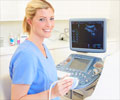
An echocardiogram can confirm the diagnosis. Ultrasound waves are used to get pictures of the heart. Blood flow through the chambers can also be visualized during this test. A shunt can be seen and the exact location of the septal defect can be found. The size of the hole can be measured. Any associated malformations can be detected using echocardiography.

Cardiac catheterization can provide information such as the oxygen levels in each heart chamber and the pressure within. This test is an interventional procedure, where a thin tube or catheter is inserted through the groin, neck or arm and pushed to the heart. This test is not indicated in all patients with septal defects.

A pulse oximetry is a simple test done to determine the amount of oxygen in blood. A sensor probe is placed on the fingertip. The machine attached to this sensor displays the oxygen saturation in blood.

Few modern tests like Cardiac MRI and Chest CT scan can now be used to confirm the diagnosis.

Some patients have the septal defect diagnosed during a routine examination. When they are asymptomatic and lead a normal life, they will be asked to come back for regular follow-ups. Surgical treatments may not be indicated.


Share it!
Comment & Contribute
Comments should be on the topic and should not be abusive. Comments are normally moderated and are reviewed after they are posted.
* Your comment can be maximum of 2500 characters

Notify me when reply is posted
I agree to the terms and conditions
  
If you have a question about health related issues, you can now post it in our Ask An Expert section on our community website Medwonders.com and get answers from our panel of experts.
Posted by:  motisagar  Posted on: 08/30/2011
HOLE IN HEART IN MY COSION HEART ,I HAVE NO MORE MONEY FOR SURGERY.MY BABY LIE ON BED AND WAITING FOR DEATH.PLEASE SUGGEST ME FOR SOME WELFARE SOSITY ,WHO HEALP MY CHILD.


Posted by:  Man56(Guest)  Posted on: 09/08/2011
dear friend, why don't u try get BPL [below poverty line]card, once this card made i belive free medicins and treatment avilable at all govt hospitals.


Posted by:  Kuotkuany  Posted on: 07/23/2011
Well and briefly explained; VSD account for upto 25% of all Cardiac Heart Failure, which simply means that 2 out of 1000 lives birth are affected. Isolated complex malformations do happened and lower left sternal edge with/or without parasternal thrill is encountered mostly during examination. Yeah/and ballabalala....


Posted by:  manuheart123  Posted on: 12/18/2010
Ventricular Septal Defect Ventricular Septal Defect is usually symptomless at birth. It usually manifests a few weeks after birth. Small VSD can be asymptomatic, but larger ones can result in heart failure, pulmonary hypertension or growth restriction with recurrent respiratory infections like pneumonia. Other features may be poor weight gain, breathlessness on breast feeding and increased heart rate. If not intervened, it can develop into Eisenmenger Syndrome, which has a very bad outcome. http://heart-consult.com


X
Related Links
Ventricular Septal Defect - Animation
Chest Pain
Circulatory System
Mitral Valve Stenosis And Mitral Valve Replacement
Mitral Valve Regurgitation and Mitral Valve Replacement
Palpitations And Arrhythmias
Pulse Rate Chart
Yoga and Heart
Citing this Health Article
The information on Medindia is factual, unbiased and authentic. If you find the content useful - PLEASE INCLUDE A LINK TO THIS PAGE.

Highlight the text, right-click, and select “copy”. Paste the link into your website, email, or any other HTML document.

News on Congenital Heart Disease
* Health of Folks With Heart Failure Better With Nordic Walking
* Lack of Vitamin D in Diet Raises Stroke Risk in Japanese-Americans
* Researchers Believe That Attention Key to Recovery in Stroke
* Infusion of Enzyme in Scar Tissue Following Chronic Stroke may Make Patients Stronger
* Research Sheds Light on Open Heart Surgery and Kidney Disease Patients
Total News Item 1099
Are you a member of Facebook? Become a fan of Medindia and get breaking news delivered to your Facebook page.