- Rajveer Hundal and Eldon A Shaffer. Gallbladder cancer: epidemiology and outcome. Clin Epidemiol. 2014; 6: 99-“109
- Enriqueta Bertran, Katy Heise, Marcelo E. Andia and Catterina Ferreccio. Gallbladder cancer: incidence and survival in a high-risk area of Chile. Int. J. Cancer: 127, 2446-“2454 (2010).
- Eldon A. Shaffer, MD. Gallbladder Cancer: The Basics. Gastroenterology & Hepatology Volume 4, Issue 10 October 2008.
- Gallbladder cancer statistics - (http://www.wcrf.org/int/cancer-facts-figures/data-specific-cancers/gallbladder-cancer-statistics)
- Gallbladder Cancer Patient Version - (http://www.cdc.gov/cancer/dcpc/research/articles/gallbladder.htm)
- Gallbladder Cancer Types - (https://www.cancer.gov/types/gallbladder)
- About Gallbladder Cancer - (http://www.cancer.org/cancer/gallbladdercancer/)
- Gallbladder cancer - (http://www.cancerresearchuk.org/about-cancer/type/gallbladder-cancer/)
What is Gallbladder Cancer?
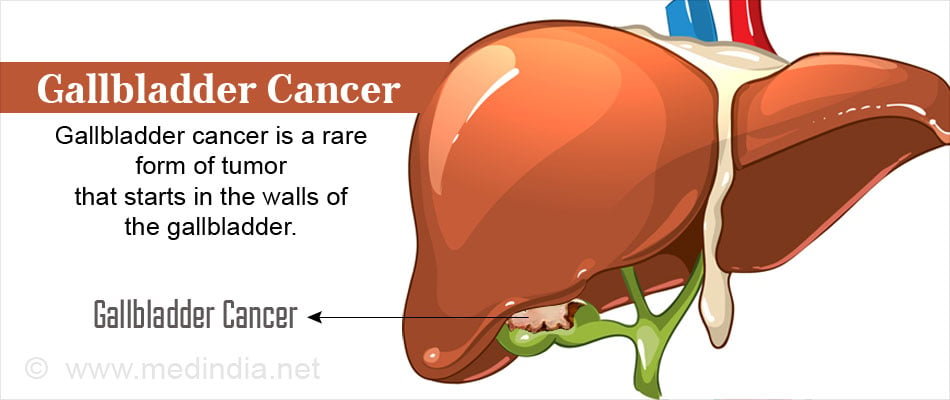
Gallbladder cancer is a rare cancer in which malignant (cancerous) transformation of cells occur in the wall of the gallbladder.
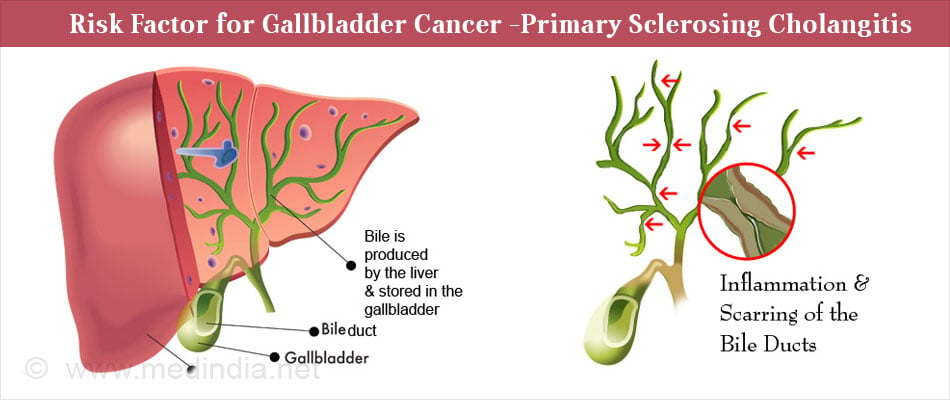
The gallbladder is a pear-shaped organ under the liver that stores bile. Bile is a fluid produced by the liver to digest fats. When food is being digested in the stomach and intestines, the gallbladder contracts and releases the bile into a tube called the cystic duct. The cystic duct joins with a duct from the liver called the common hepatic duct and together they form the common bile duct. The common bile duct then joins the pancreatic duct to empty the contents into the small intestine to aid the digestive process.
Gallbladder cancer is more commonly seen in South America (particularly Chile, Bolivia, and Ecuador), Central and Eastern Europe, Japan and Northern India. Women are affected more commonly than men. Cure is possible if the diagnosis is done early enough. Unfortunately a diagnosis is often made once symptoms occur, i.e. after the cancer advances. In such cases, the outlook is poor. Surgery is the most effective treatment for gallbladder cancer. Radiation and chemotherapy are also used.
Advertisement
Statistics on Gallbladder Cancer
Gallbladder cancer:
- Is the most common cancer of the biliary tract (80-90%) worldwide according to autopsy studies
- Has high rates of incidence in South America (Chile, Bolivia, Ecuador) and Asia (South Korea, Japan and India) and the lowest in Africa.
- Is more common in women than men.
- Is more common in Caucasians than black people.
What are the Types of Gallbladder Cancer?
- Adenocarcinomas – These cancers start in the gland-like cells of the gallbladder and account for 9 out of the 10 gallbladder cancers. Among adenocarcinomas, papillary adenocarcinoma or papillary cancer accounts for 6% of gallbladder cancers.
- Other rarer types are adenosquamous carcinoma, squamous cell carcinoma, small cell carcinoma and sarcoma.
What are Risk Factors of Gallbladder Cancer?
Risk factors for gallbladder cancer include the following:
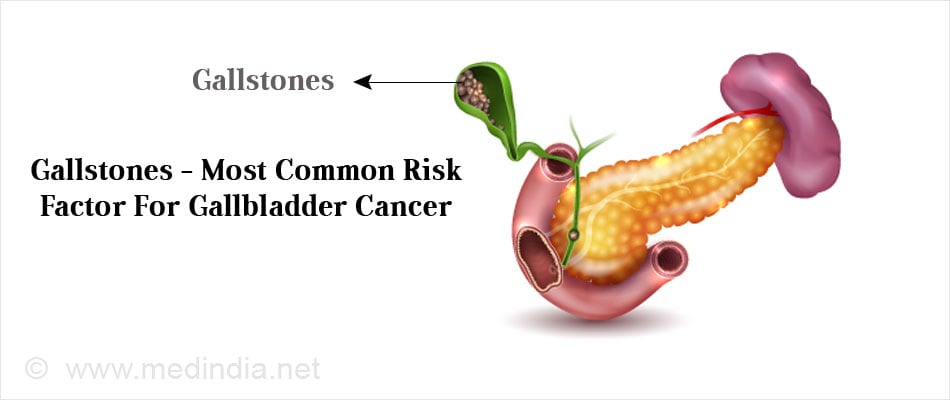
- Presence of gallstones: Gallstones are one of the strongest risk factors for gallbladder cancer. Gallbladder Stones are found in 70-90% of the people diagnosed with the cancer. The association increases with the size of the stones. One theory for why gallstones cause gallbladder cancer is that the gallbladder releases bile more slowly when gallstones are present. This exposes the gallbladder cells to chemicals in bile that could cause irritation and inflammation, thereby predisposing to cancer. It is important to note that although most people with gallbladder cancer have had gallstones in the past, only a very small percentage of people with gallstones will ultimately get gallbladder cancer.
- “Porcelain” gallbladder: This is a condition that occurs due to chronic and recurrent inflammation or the gallbladder. It is characterized by calcium deposits in the wall of the gallbladder that can be seen on certain types of radiographic imaging tests. The chronic inflammation may cause changes in the DNA of the cells making them grow abnormally and resulting in cancerous transformation.
- Salmonella infection: in certain areas of the world, a small percentage of the population are chronic carriers of a bacterium called Salmonella typhi. There appears to be a correlation between chronic Salmonella infection and gallbladder cancer.
- Pancreatico-biliary duct junction anomalies: Abnormalities at the confluence of the pancreatic and the bile ducts known as the pancreaticobiliary duct junction might cause a reflux of the pancreatic juices back into the gallbladder and the bile ducts causing inflammation. This mechanism is a more common cause of gallbladder cancer in the Asian populations.
Advertisement
Other risk factors of gallbladder cancer include:
- Gender: Gallbladder cancer is more common in women than men.
- Age: Gallbladder cancer is usually noted in older individuals
- Obesity: Obesity increases the risk of getting the cancer
- Ethnic groups: Ethnic groups like Native American Indians and Hispanics are at a high risk
- Primary sclerosing cholangitis – Primary sclerosing cholangitis is the inflammation and fibrosis of the bile ducts inside and outside the liver
- Gallbladder polyps or growths in the walls of the organ
What are the Symptoms and Signs of Gallbladder Cancer?
The early stages of gallbladder cancer may not produce any noticeable signs or symptoms. Frequently, patients are diagnosed during surgery for gallstones.
If symptoms occurs, these can include:
- Pain
- Nausea and vomiting
- Loss of appetite
- Weight Loss
- Jaundice, where yellowing of the skin and whites of the eyes occurs

- Fever
- Lumps in the abdomen due to an enlarged gallbladder and/or spread of the cancer to other areas like the liver
How is Gallbladder Cancer Diagnosed?
An early diagnosis of gallbladder cancer is difficult since the early stages of the cancer go unnoticed due to the lack of specific signs or symptoms. The diagnostic process varies depending on the situation.
In patients who are simply undergoing evaluation for symptoms of gallstones (abdominal pain, nausea, vomiting associated with eating), the following are concerning signs or symptoms that should prompt further evaluation:
- An abdominal ultrasound (a test done to visualize gallstones) that shows gallbladder calcification, a mass inside the gallbladder, a polyp > 1cm in size, or an abnormally thickened gallbladder wall.

- If any of the above abnormalities are found on ultrasound, a better imaging test (such as a computed tomography [CT] scan or magnetic resonance imaging [MRI]) can better help to determine if the observed abnormalities are due to gallbladder cancer. These tests can also help determine if the cancer has invaded other organs.
- An endoscopic retrograde cholangiopancreatography (ERCP) is a procedure that uses an endoscope that is placed down the throat and into the gastrointestinal tract and uses a camera to help enter the biliary ducts from the intestinal tract. From here, a sample of cells can be taken if necessary for diagnosis, or a blockage can be treated if there is a cancer blocking the drainage of bile.
In other situations, the cancer is found incidentally when the gallbladder is surgically removed for different reasons.
Blood tests may be used but are generally unhelpful on their own, as most available blood tests can be abnormal in a variety of situations. Tumor markers such as carcinoembryonic antigen (CEA) or carbohydrate antigen 19-9 (CA 19-9) are often elevated in gallbladder cancer, but are occasionally normal and can also be elevated in other conditions. Thus, these are not sufficient to make a diagnosis.
What are the Stages of Gallbladder Cancer?
Staging is an important part of cancer management.
The stages of gallbladder cancer are grouped according to 3 main criteria:
Advertisement
- The size and spread of the tumor inside the layers of the gallbladder
- The spread of the tumor to the lymph nodes
- The spread of the tumor to a different part or organ of the body
Gallbladder cancer may be:
- Localized (stages 1 and II) where the cancer is contained within the walls of the gallbladder. Surgery can be performed to remove the cancerous growth or the gallbladder itself.
- Advanced (stages III and IV) when the cancer has spread to the tissues outside the gallbladder either to the lymph nodes, blood vessels or other organs. The entire cancer cannot be removed or is not resectable except in the case of some stage 3 cancers. Stage 4 cancers can reappear either in the gallbladder or other organs after the first treatment.
What is the Treatment and Management of Gallbladder Cancer?
Surgical removal is the most effective treatment of gallbladder cancer. A completely curative resection is however possible only in a minority of patients. This is because most patients are diagnosed in an advanced stage of the cancer when surgery may not be possible.
When possible, the gallbladder and nearby tissues (including lymph nodes) are removed. Surgery is associated with significant mortality and morbidity.
The surgery can be a:
- Simple cholecystectomy (done laparoscopically or as an open operation) to remove the gallbladder alone
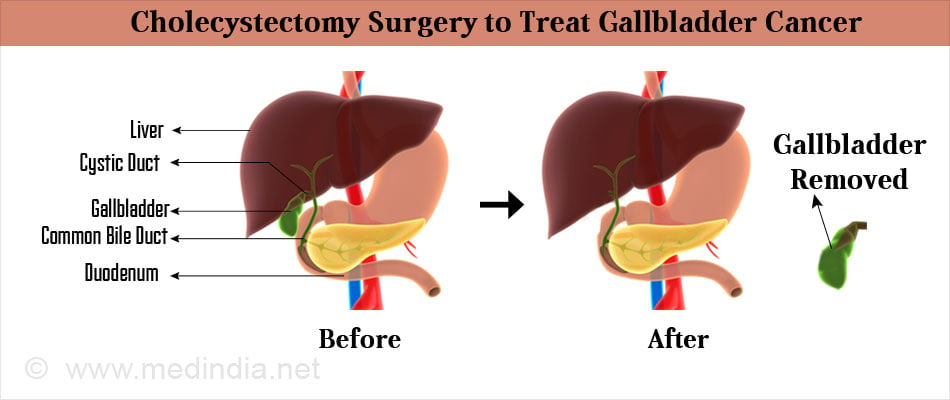
- Extended cholecystectomy that involves removing the gallbladder and parts of organs and / or lymph nodes that the cancer may have spread to.
In cases where operative removal is not possible, alternatives are called in:
- Surgical biliary bypass: A new pathway for drainage of bile is created
- Endoscopic stent placement: A stent (thin, flexible tube) is used to drain the bile into the small intestine
- Percutaneous transhepatic biliary drainage: This is also a procedure for draining bile
These procedures relieve the patient of jaundice.
Apart from surgery, radiation therapy and chemotherapy are also available for the treatment of the cancer.
Radiation Therapy
Radiation therapy is a cancer treatment where high-energy x-rays or other types of radiation are used to kill cancer cells or prevent them from growing. External beam radiation is used to treat gallbladder cancer. It may be given after surgery to destroy remaining cancer cells or in non-resectable cancers. In external radiation therapy, a machine outside the body is used to send radiation toward the cancer. The total dose of radiation therapy is sometimes divided into several smaller, equal doses which are delivered over a period of time spanning over several days.
Chemotherapy
Chemotherapy drugs may be used to stop the growth of cancer cells, either by killing the cells or by preventing them from dividing.
Chemotherapy drugs used to treat gallbladder cancer are:
- Gemcitabine
- Cisplatin
- 5-fluorouracil
- Capecitabine
- Oxaliplatin

What is the Prognosis for Gallbladder Cancer?
The outlook (prognosis) and treatment options for gallbladder cancer depend on a number of factors.
- The stage of the cancer: The extent of the cancer plays a vital deciding role
- Whether the cancer was diagnosed early
- Whether it is a recurrent case. A recurrent gallbladder cancer is one that has reappeared after complete treatment
- Whether complete surgical removal is possible
- The type of gallbladder cancer (based on microscopy)
- The general health of the patient
Localized cancer can be completely removed surgically and has a good prognosis. Advanced stages or recurrent cases have a poor prognosis. The median survival for advanced disease is short (2-4 months).