What is Cheese and How is it Made?
Cheese is made from the pasteurized milk of cows, sheep or goats. It is made by adding a starter culture of bacteria to the milk. The bacteria digest milk sugar (lactose), producing lactic acid, which separates the solids from the liquid in milk. A soft curd is formed, leaving the whey, which is drained off.
The curd can be either used fresh, heated, salted, dried, ripened or matured according to the type of cheese being made.
There are 4 main groups of cheese categorized according to techniques of production and maturity:
- Fresh unripe cheese eg. Cottage cheese, cream cheese, ricotta cheese, quark, mascarpone, feta cheese
- Soft mold ripened cheese, eg., camembert
- Firm cheese, eg., cheddar and Swiss cheese
- Hard cheese, eg., parmesan, pecorino
- Stretched curd cheese, eg., mozarella
Nutrition Value
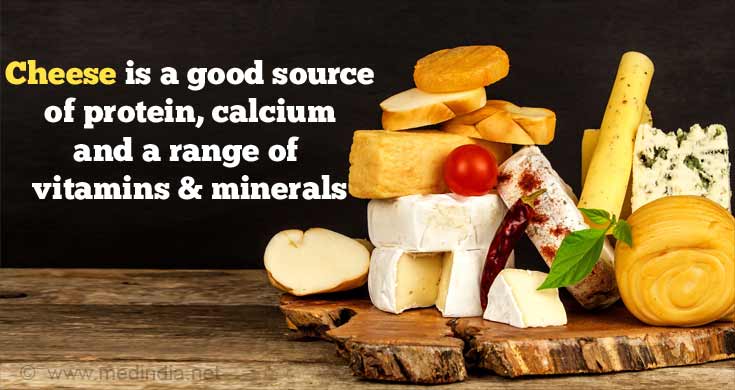
It is a good source of protein, calcium and a range of vitamins and minerals. The fat content in cheese can vary from about 50 to 85 percent in mascarpone, which is made from cream, to 35 percent in cheddar types and 5 to 10 percent in cottage cheese and ricotta.
Some cheeses are made from milk containing less fat and are labeled as ‘low fat’ cheese. A serve of cheese could vary from 25 grams (1 chiplet, 1 slice of cheddar cheese) to 40 grams (grated mozzarella cheese, parmesan cheese). It can be a wise decision to choose the reduced fat variety wherever possible as cheeses are high on saturated fat too. Cheese is rich in calcium and good quality protein too.
Calcium and fat content of different types of cheese commonly used by Indians
| Cheese type | Per serve | Fat | Calcium | Protein |
| Cheddar, processed cubes | 25 grams (1 chiplet) | 6.5 | 85 | 5 |
| Processed Cheese spread | 15 grams (1 tablespoon) | 3.3 | 51 | 2 |
| Cheddar, reduced fat | Contains 33 percent less fat than processed cheddar cheese | 2.2 | - | - |
| Cheddar, Cheese slice | 20 grams (1 slice) | 5 | 74 | 4 |
| Emmental Cheese (swiss style) | 25 grams | 11.5 | - | - |
| Mozzarella cheese | 25 grams | 8 to 10 | 204 | - |
| Malai paneer (full fat) One can opt for the low-fat variants available in the market. | 25 grams | 12.5 | - | - |
| Parmesan | 25 grams (3 to 4 tablespoons grated) | 7.5 | 342 | - |
| Feta | 25 grams | 3.75 | - | |
| Camembert | 25 grams | 6.25 | 121 | - |
| Ricotta | 25 grams | 2.8 | 56 | - |
| Gouda | 25 grams | 5.5 | - | |
| Cottage cheese | 25 grams | 3.2 | 22 | - |
Among the above variants, it is evident that cheese is a good source of calcium and protein. A small cube of it can be a great high protein snack option.
Some are particularly low on fat and choosing them over others can be a judicious choice. Cheddar cheese, most commonly eaten by most people is quite low on fat as compared to cottage cheese (paneer), swiss-style cheese, mozzarella cheese. Opting for the low-fat variants of cheese slices, cubes and spreads is a healthier option with the protein and calcium content being the same or more and the bad fat content being lesser.

The protein obtained from cheese is the good quality protein which means that most of it is bioavailable to the body and hence easily absorbable. An average of 5 to 6 grams of protein can be obtained from 25 grams (single serve) of this dairy product.
Cheese spread versus butter and the low fat options:
| Per 100g | Lite Butter | Butter | Margarine | Cheese Spread | Cheese Slimz Spread (33 Percent Low- Fat) |
| Total Fat % | 59 | 80 | 80 | 22 (11.5 g - Protein, 343 mg Calcium, 604 mg phosphorous | 14.7 |
| Milk Fat % | 10 | 80 | 0 | - | - |
| Vegetable Fat % | 49 | 0 | 80 | - | - |
| Cholesterol | 26 mg | 210 | 0 | - | - |
| Total Calories | 531 | 720 | 720 | 252 | - |
It is astonishing to know that the fat content of regular cheese spreads fall much lower than the low-fat butter too. We should consider opting for cheese spreads over regular butter. Cheese spread as evident from the table above give lesser calories, and in addition provides protein, calcium, vitamin A and phosphorous.
Provided we stick to the serving size we can willingly opt for cheese over other high-fat variants without guilt.