Anthrax - Bacillus - Symptoms - Diagnosis - Treatment - FAQs
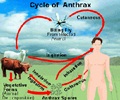
Anthrax is caused by the bacterium Bacillus anthracis and spreads when the anthrax spores are inhaled, ingested, or come into contact with the skin lesion on a host.
Anthrax is caused by the bacterium Bacillus anthracis and spreads when the anthrax spores are inhaled, ingested, or come into contact with the skin lesion on a host.
The research also highlights the need for safe on-site assessment of casualties and for civilian doctors to be trained by military personnel experienced in the sort of injuries seen in terrorist attacks.
"We were the closest hospitals to the attack and dealt with 271 casualties, including 108 who were dead on admission. Of the remaining 163 patients, 23 were discharged after outpatient care and 140 were admitted. We carried out 194 operations on 127 patients and six people died following surgery," Professor Ajay Bhandarwar, from the Sir Jamshetjee Jejeebhoy Group of Hospitals in Mumbai.

Bioterrorism-an interactive analysis
Interactive section of Medindia gives general the analysed information about bioterrorism
Interactive section of Medindia gives general the analysed information about bioterrorism
"The 2008 attacks caused both physical and emotional damage to the people of Mumbai, but also produced unique cooperation between medical and administrative facilities, the media and non government organisations," said Professor Bhandarwar.
Advertisement

NIMH Grants Funds To Study The Impact Of Terrorism
A grant of $2.25 million has been awarded by National Institute of Mental Health (NIMH) to study the impact of terrorism and its effect on mental health of the people.
A grant of $2.25 million has been awarded by National Institute of Mental Health (NIMH) to study the impact of terrorism and its effect on mental health of the people.
"However, the same basic principles can be adopted by other hospitals worldwide, and tailored to their own particular resources, so that they too are prepared to meet the challenges posed by major incidents involving mass casualties."
Advertisement

Nature Unleashes Terror Across America
Mother Nature seems to be furious. Across both coasts of America and in the Midwest regions, two forms of severe weather have put citizens to the extreme test.
Mother Nature seems to be furious. Across both coasts of America and in the Midwest regions, two forms of severe weather have put citizens to the extreme test.
The senior surgeon who assessed the casualties as they were brought in played a key role in selecting patients for admission and surgery, resulting in a steady flow of patients.
The majority of the patients were aged 20 to 39 years and the dominant injury was limb trauma, seen in 117 patients. Most of the surviving patients had bullet injuries, followed by pellet injuries and a smaller number of blast injuries.
Most of the surgical procedures were for soft tissue or orthopaedic injuries and, where possible, these were operated on using local or regional anaesthesia.
The surgeons also dealt with a wide spectrum of injuries including colon tears, bowel perforations, damage to the liver, spleen and kidneys and chest trauma.
Non-governmental organisations assisted by providing extra medical supplies and the media displayed lists of patients to keep relatives up-dated and helped to mobilise blood donors.
"Managing a prolonged terrorist attack needs teamwork for efficient medical management and best outcomes," stressed Professor Bhandarwar.
"There is no doubt whatsoever that our experience of handling victims of four previous Mumbai blasts, and the development of an effective and highly detailed disaster management plan, enabled us to cope effectively with this major ongoing incident with multiple casualties," Professor Bhandarwar added.
The study has been published in BJS, the British Journal of Surgery.
Source-ANI