As per the estimates of the World Health Organization (WHO), there are approximately 63 million people in India suffering from significant auditory impairment. This places the prevalence at 6.3 percent of the nation's population.
According to the National Sample Survey Organisation 2001 survey, there are currently 291 persons per one lakh population suffering from severe to profound hearing loss.Of them, a large percentage are children below the age of 14 years. Then there are the elders above 60 years of age and the lifestyle changes that the impairment forces on them. Self-esteem could be badly affected.
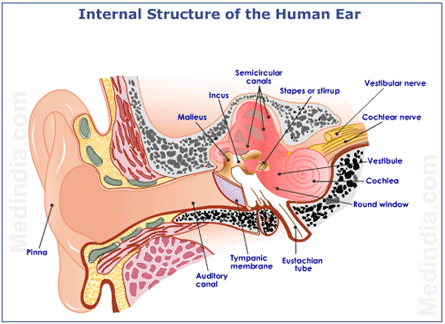
The cochlea is the auditory portion of the inner ear.Contrary to hearing aids, cochlear implants do not amplify sound. Instead they use electrical impulses to directly stimulate any functioning auditory nerves within the cochlea. External components of the cochlear implant include a microphone, a speech processor and a transmitter.
Under appropriate conditions, an implant can give a deaf person a useful auditory understanding of the environment and/or hearing and help them to understand speech, although post-implantation therapy is usually required. According to researchers at the University of Michigan, approximately 100,000 people worldwide have received cochlear implants; roughly half of them being children.
At the moment the benefit of the implant does not reach many because of the prohibitive cost of the device, surgery and post-implantation therapy.
Advertisement
The initiative of India’s former president APJ Abdul Kalam, fondly known as a people’s president, is quite relevant in this context. He is seeking to develop a cheaper cochlear implant through the Defence Research and Development Organisation (DRDO), and that could transform the lives of millions worldwide.
Advertisement
But the Indian version could take many more years as the technology is sophisticated and highly advanced, say ENT specialists. At present, the country has very few public or government hospitals performing cochlear implants. The fact that the whole country must have performed only about 1000 to 2000 implants all these years tells its own story.
``The implant replaces the inner ear, not physically but functionally. It is only for patients with profound hearing loss. People who can't hear at all even with the most powerful hearing device,'' '' says Dr Lt Col A. Ravi Kumar, Professor and Head, Department of ENT, Head and Neck Surgery, Sri Ramachandra Medical College & Research Institute. The prestigious institution, situated in Chennai, capital of the southern Indian state of Tamil Nadu, is the only medical college in the state to perform cochlear implants.
As it is surgically replaced, the patient has to go through a detailed audiological investigation to learn the functionality of the ear using hearing aids and a CT / MRI scan to find out if the ear is structurally developed or not. The delicate surgery done most meticulously lasts for about 3 to 4 hours under anaesthesia without any risk to the nerves. The implant is for life. The inner part is permanent and the outer part should be replaced once in seven years.
Apart from the ENT surgeons, audiologists, speech therapists, auditory verbal therapists, social workers and counselors are part of the ``habilitation'' programme. It must be noted that the surgical implant is only a part of the programme. Equally important is the counseling, to the parents, in case of implants in children. While adults need the therapy for a few months, the children will have to undergo counseling, training and therapy for about two years; a hugely expensive proposition!
Among the 40 odd hospitals involved in cochlear implant, very few are supported by state or central governments. Besides, the banks are reluctant to come forward to advance loans towards cochlear implants. The father of a child who underwent implant at SRMC is a senior bank official. Still, he could not get loans for the purpose and had to go for personal loans, Dr Ravi Kumar recalled.
Dr. Ravi kumar suggests that the National Programme for Deafness fund the cochlear implants. At present it is oriented only towards preventive measures. He wanted the Government to evolve a policy that would induce banks to reach out to the hearing-impaired, especially children. He also wanted the government to focus on the need to vaccinate girls against rubella, commonly known as German measles, a disease caused by the rubella virus. The vaccination is crucial for girls getting married.
Rubella in the first three months of pregnancy could result in hearing, vision and even cardiac problems in the child. Unfortunately the rubella attack could pass unnoticed - the dangers inherent in such a situation are obvious then. According to studies carried out in the African continent, vaccination against rubella could reduce hearing loss in children by as much as 40 percent.
Better maternal health care and post-natal care are also important. Children born with higher billirubin count would have to be closely watched. Billirubin is a chemical formed during red blood cells metabolisis.It is excreted from the liver through the bile. When the liver cells are damaged, a build-up of billirubin in the blood and extra-cellular fluid results which in turn may damage the nerves that control hearing.
Parents should be sensitized to test the sensory perceptions of the newborn, Ravikumar insists. Early detection is the key. Solid studies have revealed that children identified with the problem and accorded treatment early do well enough to live like normal children. It is possible to treat deafness very early in life (before three years). Specialists in the field also talk about the need to train thousands of audiologists and audio-therapists as there is a huge shortage of manpower.
Unlike the case of other surgeries, the ENT segment depends equally on experts in allied field for continued treatment, training and counseling. Prof. Roopa Nagarajan of the Department of Speech, Language and Hearing Sciences, SRMC is one such expert. She points to another area of serious concern - that of unabated noise pollution in modern life. She regrets that there is very little public awareness of this growing menace.
Earlier, noise pollution was restricted to industrial environment. Now youngsters plug in to i-Pods all the time, whose decibel levels could be as much as two times higher than what emanates from a factory in normal circumstances. Noise-induced hearing loss would not manifest itself immediately but would be known only after 5 to 10 years, Dr Roopa says and calls for sustained campaigns to make youngsters aware of the dangers they are courting.
Source-Medindia