Study on Asians found that individuals with normal weight were far less likely to die from cancer, heart disease or other causes than those with very high or low BMI.
If you are an Asian, you don’t have to be obese to suffer from obesity related diseases. Are Asians on a different obesity scale?
Obesity - Causes, Symptoms, Diagnosis, Complications, Treatment
Obesity is a condition where there is excess accumulation of body fat which poses a risk to the health of the individual. It can affect children and adults.
Obesity is a condition where there is excess accumulation of body fat which poses a risk to the health of the individual. It can affect children and adults.
Dr. Wei Zheng of Vanderbilt-Ingram Cancer Center, Tennessee and his colleagues observed that most studies evaluated the association between BMI and risks of death from specific causes on European populations but the validity of these criteria in Asian populations is yet to be determined. According to Dr. Zheng, “A large number of Asians are very thin and the impact of a severely low BMI on the risk of death has not been well evaluated until now”. This observation made them perform pooled analyses to evaluate the link between BMI and risk of death in Asians.
The study which was conducted as part of the “Asia Cohort Consortium” included health status and mortality information of more than 1.1 million individuals from East and South Asia over a period of 9.2 years. BMI was defined as weight in kilograms divided by the square of height in meters.

Body Mass Index
The BMI calculator helps you assess your weight indicating if it is normal or if you are underweight or overweight, based on your height.
The BMI calculator helps you assess your weight indicating if it is normal or if you are underweight or overweight, based on your height.
East Asians with a raised BMI of 35.0 or higher had a 50 percent higher risk of death. Interestingly, the study found that the same does not hold true for Indians and Bangladeshis. This goes to show that a high BMI does not affect all ethnic groups in the same way.
Advertisement

Ideal Body Weight
Calculate the ideal body weight for adults easily with Medindia’s Ideal Body Weight Calculator.
Calculate the ideal body weight for adults easily with Medindia’s Ideal Body Weight Calculator.
Associate Investigator Paolo Boffetta, MD, Professor at Mount Sinai School of Medicine, New York explained, "Severe underweight was highly prevalent in Asia in the past, and we can still observe its important impact on mortality. However, prevention of overweight and obesity deserves the highest priority."
Advertisement
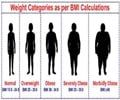
Body Mass Index (BMI)
Body mass index (BMI) is a simple tool that is generally used to estimate the total amount of body fat.
Body mass index (BMI) is a simple tool that is generally used to estimate the total amount of body fat.
The authors concluded that their study provides strong evidence of biologic relevance that weight contributes to a higher risk of death. Being underweight is associated with increased risk of death in all Asian populations. However, the excess risk of death associated with a high BMI has been seen among East Asians but not among Indians and Bangladeshis.
Reference:
http://www.nejm.org/doi/full/10.1056/NEJMoa1010679
Source-Medindia