Health Effects of Global Warming
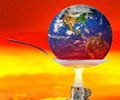
Greenhouse effect causes excessive heat to build up in the earth’s atmosphere causing global warming and affects the environment and health.
Greenhouse effect causes excessive heat to build up in the earth’s atmosphere causing global warming and affects the environment and health.
"But the problem appears to be in their response to the intense short-term cooling that occurs following a very large volcanic eruption. Explosive volcanic eruptions place particulates called aerosols into the stratosphere, reflecting back some fraction of incoming sunlight and cooling the planet for several years following the eruption."
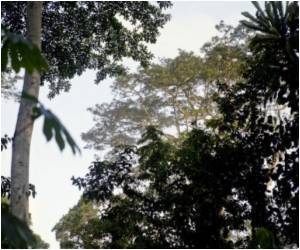
Tree rings are used as proxies for climate because trees create unique rings each year that often reflect the weather conditions that influenced the growing season that year.

Climate Change Reorganized Tibetan Culture 700 Years Ago: Study
Changes in weather 700 years ago might have forced Tibetans to reorganize their society, an anthropologist has claimed.
Changes in weather 700 years ago might have forced Tibetans to reorganize their society, an anthropologist has claimed.
"The problem is that these trees are so close to the threshold for growth, that if the temperature drops just a couple of degrees, there is little or no growth and a loss of sensitivity to any further cooling. In extreme cases, there may be no growth ring at all," said Mann.
Advertisement

World Cities Join Hands to Combat Climate Change
Fifteen of the world's largest cities have agreed on a initiative with major banks to retrofit buildings in their cities to save energy, in the first such enterprise to combat climate change.
Fifteen of the world's largest cities have agreed on a initiative with major banks to retrofit buildings in their cities to save energy, in the first such enterprise to combat climate change.
The researchers compared temperature reconstructions from actual tree-ring data with temperature estimates from climate models driven with past volcanic eruptions.
Advertisement

Double Pace of CO2 Reductions to Avoid Dangerous Climate Change, Large Firms Told
The world's largest companies need to double the pace of carbon dioxide (CO2) reductions to avoid dangerous climate change says a new research report.
The world's largest companies need to double the pace of carbon dioxide (CO2) reductions to avoid dangerous climate change says a new research report.
However "there is one glaring inconsistency; the response to the three largest tropical eruptions - AD 1258/1259, 1452/1453 and the 1809+1815 double pulse of eruptions - is sharply reduced in the reconstruction."
Following the 1258 eruption, the climate model simulations predict a drop of 3.5 degrees Fahrenheit, but the tree ring-based reconstruction shows only about a 1 degree Fahrenheit dip and the dip occurs several years too late. The other large eruptions showed the same type of discrepancy.
Using a theoretical model of tree-growth driven by the simulated temperature changes, the team determined that the cooling response recorded by the trees after a volcanic eruption was limited by biological growth effects.
Any temperature drop exceeding roughly 1 degree Fahrenheit would lead to minimal tree growth and an inability of trees to record any further cooling.
When growth is minimal enough, it is likely that a ring will not be detectable for that year.
The potential absence of rings in the first one to three years following eruption further degrades the temperature reconstruction.
Because tree-ring information is averaged across many locations to obtain a representative estimate of northern hemisphere temperature, tree-ring records with and without missing rings for a given year are merged, leading to a smearing and reduced and delayed apparent cooling.
The researchers also noted that aerosol particles forced into the air by volcanoes block some direct sunlight causing cooling and they produce more indirect, scattered light at the surface. Trees like indirect sunlight and grow better under those conditions.
However, this effect is small compared to that of lower temperatures and shorter growing seasons.
By accounting for these various effects in the tree growth model, the researchers were able to reproduce the reduced and smeared cooling seen in the actual tree-ring temperature reconstruction, including the near absence and delay of cooling following the massive 1258 eruption.
"Our findings suggest that past studies using tree-ring data to infer this sensitivity have likely underestimated it," Mann added.
The study has been published in Nature Geoscience.
Source-ANI