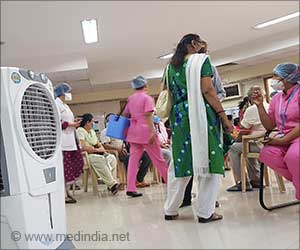
Certification on products and services has become imperative to ensure safety and reliability. A similar standard for health care services is also vital since people trust hospital services and clinics with their lives. Dr. Narottam Puri, MBBS, MS (ENT), FICS, FIAMS, ADHA and Chairman, National Accreditation Board for Hospitals and Healthcare (NABH), India delivered an oration on 'Accreditation-Improving Healthcare Quality in India' commemorating the sixth 'Prof.T.K. Partha Sarathy Endowment Oration' at Sri Ramachandra University,Chennai on 9th February 2012.
Accreditation Credits Credibility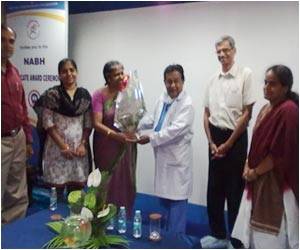
World Standards Day 2011 - Q&A on Healthcare Standards in India
For World Standards Day 2011 Medindia discussed healthcare standards in India with Ms. Rama Venugopal, Executive Director, Value Added Corporate Services, based in Chennai, South India.
For World Standards Day 2011 Medindia discussed healthcare standards in India with Ms. Rama Venugopal, Executive Director, Value Added Corporate Services, based in Chennai, South India.
Accreditation is Beneficial
Currently most part of health care facility in India is in the hands of the private sector and a marginal portion belongs to the government. According to Dr. Puri, private hospitals offer services that are partly treated like hotels and partly handled as medical fragment, the latter of course taken for granted and not questioned. So an assessor (NABH authorised supervising personnel) does not merely check if a hospital meets the guidelines. NABH also monitors if the hospital meets the standards set by the self in the previous year, what is termed as the Continuous Quality Improvement (CQI), which like in any other management helps maintain or even improve the quality of healthcare services. As for benefitting the staff, accreditation provides good working environment and promotes ownership of clinical processes. For example instead of penalising a nurse over an error, Dr. Puri suggested explaining to the nurse the need to bear responsibility for his/her actions, so as to avoid them in the future. Finally addressing the advantage of accreditation to others, such as members availing (Central Government Health Scheme) CGHS and civilians it assures “accessibility to reliable and certified information on facilities, infrastructure and level of care.”

NABH Health accreditations final draft to be released by this month
Indian Hospitals would have to apply for Health care accreditation standards that will make them compile to Quality standards and strict hygienic conditions.
Indian Hospitals would have to apply for Health care accreditation standards that will make them compile to Quality standards and strict hygienic conditions.
The three ‘A’s emphasised by Dr. Puri concerning hospital and healthcare services are Accessibility, Affordability and Assurance. NABH is striving to establish the third A – Assurance in the healthcare services. The NABH which emerged as a national body is uniquely tailored for Indian healthcare system and was an initiative by India to provide good quality services. Dr. Puri did not deny non-availability and non-affordability of healthcare services, but reinstated the achievement of excellence in healthcare industry via NABH. Observing the lack of surprise checks by NABH to uphold standards, last week Dr. Puri proposed the plan to the body. Furthermore governments have mandated and even requested NABH to frame standards on occasions such as the Kerala government requesting to set minimum standards for the average lab. So a lab accredited at level 3 can improve to reach a level 5. Similarly, to frame the Clinical Establishment Act, the central government has asked the NABH to develop standards to judge or assess a nursing home.
Advertisement

Standards for Healthcare and Wellness Industry Launched in India
It was business not as usual at the recent India Retail Forum (IRF) event as the Quality Council of India (QCI) launched the Standards for the Indian Health and Wellness Industry, at the Quality Wellness workshop.
It was business not as usual at the recent India Retail Forum (IRF) event as the Quality Council of India (QCI) launched the Standards for the Indian Health and Wellness Industry, at the Quality Wellness workshop.
Source-Medindia

Manipur Hosts a Food Safety Awareness Programme
A two-day food safety and quality awareness programme was recently held here to make people aware about food safety and the changes in Indian cuisine regulations.
A two-day food safety and quality awareness programme was recently held here to make people aware about food safety and the changes in Indian cuisine regulations.