
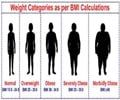
Body Mass Index (BMI)
Body mass index (BMI) is a simple tool that is generally used to estimate the total amount of body fat.
Body mass index (BMI) is a simple tool that is generally used to estimate the total amount of body fat.
"This goes back to Max Kleiber's work on resting metabolic rates for different sized animals. He found that the bigger you are the slower each gram of tissue uses energy," explained Weyand.
Intrigued by the question of why smaller people use more energy per kilogram body mass than larger individuals when walking, Weyand and colleagues decided to measure the metabolic rates of children and adults, to try to find out why larger people are more economical walkers than smaller people.
Obesity - Causes, Symptoms, Diagnosis, Complications, Treatment
Obesity is a condition where there is excess accumulation of body fat which poses a risk to the health of the individual. It can affect children and adults.
Obesity is a condition where there is excess accumulation of body fat which poses a risk to the health of the individual. It can affect children and adults.
They also derived a fundamental equation to calculate exactly how much energy walkers use with direct applications in all walks of life.
Advertisement

Weight Loss Drugs (Diet Pills)
Diet pills are medicines that help control or reduce weight. Diet pills are otherwise know as weight loss drugs or anti-obesity medications.
Diet pills are medicines that help control or reduce weight. Diet pills are otherwise know as weight loss drugs or anti-obesity medications.
Next the team calculated the amount of energy that each person used for walking by subtracting the basal metabolic rate from the total metabolic rate measured while walking.
Advertisement
Analysing the walkers' styles, the team found that all of them moved in exactly the same way regardless of their height.
They also discovered that walkers use the same amount of energy per stride regardless of their height.
Moreover, the researchers found that the walkers' energy costs were inversely proportional to their heights, with tall people walking more economically than short/smaller people because they have longer strides and have to take fewer steps to cover the same distance.
So smaller people tire faster because each step costs the same and they have to take more steps to cover the same distance or travel at the same speed.
Based on this discovery the group derived an equation that can be used to calculate the energetic cost of walking.
"The equation allows you to use your height, weight and distance walked to determine how many calories you burn," said Weyand.
The findings were published in the Journal of Experimental Biology.
Source-ANI