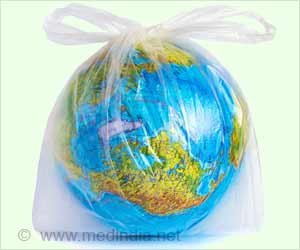
In an exploration of the 'great Pacific Ocean garbage patch', scientists from the Scripps Environmental Accumulation of Plastic Expedition (SEAPLEX) have discovered extensive plastic debris floating 1,000 miles from land.
The Scripps research vessel (R/V) New Horizon left its San Diego homeport on August 2, 2009, for the North Pacific Ocean Gyre, located some 1,000 miles off California's coast, and returned on August 21, 2009.
Mothers' Plastic Exposure Causes Fertility Defect in Child
Mothers' exposure to the chemical bisphenol A (BPA), which is found in plastic household items like plastic cans and bottles, may make their offspring prone to a fertility defect,
Mothers' exposure to the chemical bisphenol A (BPA), which is found in plastic household items like plastic cans and bottles, may make their offspring prone to a fertility defect,
Before this research, little was known about the size of the "garbage patch" and the threats it poses to marine life and the gyre's biological environment.
The expedition was led by a team of Scripps Institution of Oceanography (SIO) graduate students, with support from University of California Ship Funds, the National Science Foundation (NSF) and Project Kaisei.

"Self- Healing" Plastic May Facilitate Recycling Of E-Waste
Scientists in The Netherlands are reporting development of a new plastic with a self-healing polymer that has potential for use in the first easy-to-recycle computer circuit boards.
Scientists in The Netherlands are reporting development of a new plastic with a self-healing polymer that has potential for use in the first easy-to-recycle computer circuit boards.
"We hope that SEAPLEX will result in increased awareness of a growing issue," she added.
Advertisement

Polythene, Plastic Materials Pose Threat to Shimla's Environment
A serious threat is posed to the environment in Himachal's Shimla district due to the unending dumping and burning of polythene and plastic material in and around despite a prevailing
A serious threat is posed to the environment in Himachal's Shimla district due to the unending dumping and burning of polythene and plastic material in and around despite a prevailing
Team members began 24-hour sampling periods using a variety of tow nets to collect debris at several ocean depths.
Advertisement
World Waking Up to the Plastic Plague, US too Forced to Act
Plastic is an environmental disaster. The world is slowly waking up to the danger and the campaign against the use of plastic is gathering momentum in US.
Plastic is an environmental disaster. The world is slowly waking up to the danger and the campaign against the use of plastic is gathering momentum in US.
The scientists found that at numerous areas in the gyre, flecks of plastic were abundant and easily spotted against the deep blue seawater.
Among the assortment of items retrieved were plastic bottles with a variety of biological inhabitants. The scientists also collected jellyfish called by-the-wind sailors (Velella velella).
On August 11th, the researchers encountered a large net entwined with plastic and various marine organisms.
They also recovered several plastic bottles covered with ocean animals, including large barnacles.
By the end of the expedition, the researchers were intrigued by the gyre, but had seen their fill of its trash.
"Finding so much plastic there was shocking," said Goldstein. "How could there be this much plastic floating in a random patch of ocean - a thousand miles from land?" he pondered.
Source-ANI
SRM