Oral Cancer | Mouth Cancer - Types, Causes, Symptoms, Diagnosis, Treatment & Prevention
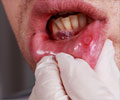
Oral cancer is a cancer that develops in any part of the mouth. It is more common in men over 40.
Oral cancer is a cancer that develops in any part of the mouth. It is more common in men over 40.
In addition to taking a day or more for results, current diagnostic methods are subjective, based on visual interpretations of cell shape and structure. A small sample of suspect tissue is taken from a patient, and a stain is added to make certain features of the cells easier to see. A pathologist looks at the sample under a microscope to see if the cells look unusual, often consulting other pathologists to confirm a diagnosis.
"The diagnosis is made based on very subjective interpretation - how the cells are laid out, the structure, the morphology," said Boppart, who is also affiliated with the university's Beckman Institute for Advanced Science and Technology.

Peritoneal Cancer – Types – Symptoms and Signs – Diagnosis - Treatment
Peritoneal cancer is a rare cancer that develops in the peritoneum. Peritoneal cancers may be primary or secondary and symptoms of peritoneal cancer are vague.
Peritoneal cancer is a rare cancer that develops in the peritoneum. Peritoneal cancers may be primary or secondary and symptoms of peritoneal cancer are vague.
Rather than focus on cell and tissue structure, NIVI assesses and constructs images based on molecular composition. Normal cells have high concentrations of lipids, but cancerous cells produce more protein. By identifying cells with abnormally high protein concentrations, the researchers could accurately differentiate between tumors and healthy tissue - without waiting for stain to set in.
Advertisement
Promising Way in Getting Cancer Cells to Destroy Themselves
The latest attack against cancer is through a new method that triggers cancer cells to destroy themselves while keeping the healthy cells untouched.
The latest attack against cancer is through a new method that triggers cancer cells to destroy themselves while keeping the healthy cells untouched.
"The analogy is like pushing someone on a swing. If you push at the right time point, the person on the swing will go higher and higher. If you don't push at the right point in the swing, the person stops," Boppart said.
Advertisement

Healthy Cells Shield Cancer Cells, In Response to Chemo
New insight into the factors that allow some lingering tumor cells to resist treatment and to seed that kind of resurgence has been shed by researchers
New insight into the factors that allow some lingering tumor cells to resist treatment and to seed that kind of resurgence has been shed by researchers
One of NIVI's two beams of light acts as a reference, so that combining that beam with the signal produced by the excited sample cancels out background noise and isolates the molecular signal. Statistical analysis of the resulting spectrum produces a color-coded image at each point in the tissue: blue for normal cells, red for cancer.
Another advantage of the NIVI technique is more exact mapping of tumor boundaries, a murky area for many pathologists. The margin of uncertainty in visual diagnosis can be a wide area of tissue as pathologists struggle to discern where a tumor ends and normal tissue begins. The red-blue color coding shows an uncertain boundary zone of about 100 microns - merely a cell or two.
"Sometimes it's very hard to tell visually whether a cell is normal or abnormal," Boppart said. "But molecularly, there are fairly clear signatures."
The findings will be published in the journal Cancer Research.
Source-ANI