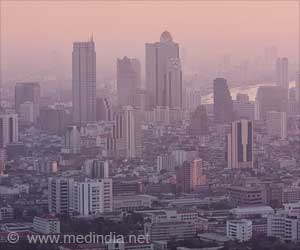
The mechanism behind how pollution is changing the weather at weekends in some of the countries in Europe has been identified by a team of researchers.
It's been known for years that man-made pollution affects weather patterns.
Water Quality At Western Yamuna Canal Meets The Desired Water Quality Standards
Water quality at western Yamuna canal meets the desired water quality standards.
Water quality at western Yamuna canal meets the desired water quality standards.
Interestingly, summer weekends are correspondingly colder and wetter.
Arturo Sanchez-Lorenzo, a climatologist at the University of Barcelona in Spain, and his colleagues studied 44 years of climate data from 13 weather stations across rural and urban areas of Spain, and extended their research by surveying sea level pressures for western Europe.

Chemical Leak In China Leaves One Dead, Hundreds Sick
At least one person has died and hundreds taken ill in central China from drinking tap water tainted by a chemical leak.
At least one person has died and hundreds taken ill in central China from drinking tap water tainted by a chemical leak.
Indeed, weekly cycles in weather have been reported for several areas. Parts of the United States have less rainfall on weekends, while Germany gets more rain at the end of the week.
Advertisement

Beijing�s Air Pollution may Not Go Away in Time for Olympics Next Year
Experts apprehend the air pollution levels may not become any the safer in time for Olympics next year.
Experts apprehend the air pollution levels may not become any the safer in time for Olympics next year.
The emission of smoke and gases has been known to affect rainfall since the 1920s.
Advertisement

Beijing's Poor Air Quality can Affect Athletes With Asthma
The heat and humidity in the Beijing region will present a formidable challenge to all the Olympians, according to a group of researchers.
The heat and humidity in the Beijing region will present a formidable challenge to all the Olympians, according to a group of researchers.
This complicated interaction means that scientists are unsure exactly how the cycle develops.
"We suggest that (these weekly cycles) are related to changes in atmospheric circulation over western Europe, maybe due to some indirect effect and interaction of aerosols with atmospheric dynamics," said Sanchez-Lorenzo.
David Parker, of the UK Meteorological Office in Exeter, agrees that the anthropogenic emissions of aerosol particles, through their impacts on cloud dynamics, can affect the amount of solar radiation reaching Earth's surface and therefore atmospheric circulation.
But, according to him, more detailed experiments on the effect of weekly-varying aerosols on weather and climate are needed to confirm this mechanism.
Source-ANI
RAS/S