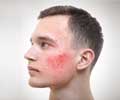
Sulforaphane, a chemical present at high levels in a precursor form in broccoli and related veggies (cauliflower, Brussels sprouts, etc.), helps prevent the severe blistering and skin breakage brought on by the rare and potentially fatal genetic disease epidermolysis bullosa simplex (EBS).
The researchers treated newborn mice with a severe form of EBS—so bad they all died within three days—with a topical solution containing sulforaphane and found marked improvement; after four days more than 85 percent of the treated mice were alive and blister-free. These findings appear online this week in Proceedings of the National Academy of Sciences.The basis of EBS, notes study author Pierre Coulombe, Ph.D., professor of biological chemistry, lies in two specific genes that make proteins known as keratins. Normally, the keratins join together and form highly resilient fibers in the lower portion of skin, helping make it durable. If either keratin is defective, they don’t mesh and the lower skin tissue becomes unusually fragile and gets damaged from the mildest mechanical stress — leading to blistering pain, a higher risk of infection, and in the most severe cases, death.
'Humans have around 54 distinct keratins, many of which are similar in structure and function,' says Coulombe. 'We figured we might be able to exploit this similarity and dial up a replacement by triggering the activation of a suitable signaling pathway in skin.' He predicted that sulforaphane might stimulate the formation of a surrogate skin-strengthening keratin to stand in for the defective one.
The desire to learn more about sulforaphane led Coulombe and his co-workers to Paul Talalay, M.D., professor of pharmacology who had previously identified sulforaphane as a cancer-preventive agent. 'It turns out that treatment with low doses of sulforaphane triggers the expression of selected keratin genes in skin,' says Coulombe. 'So we began what evolved into a highly rewarding collaboration and found it does indeed work in a mouse model for EBS.'
'This is the first suggestion that we may be able to treat this terrible disease,' adds Talalay, a co-author of this study. 'And we didn’t need to invent a new drug; sulforaphane is naturally found in our diet.'
The team will next test whether sulforaphane can stimulate the proper keratin protein in the appropriate subset of human skin cells — a vital matter for any future medical hopes. Beyond that are issues of how effective a topical application would be on human skin, which is considerably thicker than mouse skin, as well as examining the long term effects of sulforaphane treatment.
Advertisement
Source-Eurekalert
SRM/J