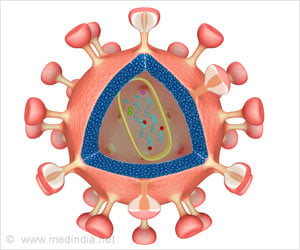
Stanford University School of Medicine's researchers recently put together a list of 93 common mutations of the AIDS virus, which can be associated to its drug resistance.
The researchers, who carried out this work in collaboration with the World Health Organization and seven other laboratories, say that the list can be used to track future resistance trends throughout the world.
AIDS - Health Education
Encyclopedia section of medindia gives general info about AIDS information and health education.
Encyclopedia section of medindia gives general info about AIDS information and health education.
"The epidemic is changing, especially as new drugs are being developed," said Dr. Robert Shafer, associate professor of infectious diseases and geographic medicine at Stanford and the senior author of the paper.
"To effectively track the spread of drug resistance, particularly transmitted drug resistance, you need a sensitive and specific list that's considered standard and is adopted by all the surveillance studies," he added.

AIDS/HIV - Prevention
Encyclopedia section of medindia explains in brief about the prevention for AIDS/HIV
Encyclopedia section of medindia explains in brief about the prevention for AIDS/HIV
In 2007, Shafer and his colleagues published a similar list of 80 HIV mutations, which that has since served as the basis for global AIDS surveillance work.
Advertisement

AIDS/HIV Treatment
Encyclopedia section of medindia explains in brief about the treatment for AIDS/HIV
Encyclopedia section of medindia explains in brief about the treatment for AIDS/HIV
For compiling the latest list, the researchers added data from other laboratories in Europe, Canada and the United States to include more than 15,000 sequences from untreated individuals, double the number available in 2007.
Advertisement

The result was that 16 new mutations were added to the 2007 list, while three were dropped.
Shafer said that it was reassuring to find minimal changes were needed.
"It shows the first list was quite good," he said.
Source-ANI
TAN/L