Researchers in The Netherlands have confirmed that business travellers who fly frequently are at an increased risk of developing life-threatening blood clots.
Life-threatening blood clots and flying have been linked for more than 50 years, but this is the first study to confirm this association."There is some evidence that the low air pressure in a plane affects the complex coagulation system of the blood," the International Herald Tribune quoted Frits Rosendaal of Leiden University Medical Center as saying.
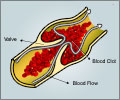
A blood clot that forms within large, deep veins of the body, usually in the leg, is called a deep vein thrombosis or DVT. If left untreated, part of the clot may break off and travel to the lungs, where it can cause a pulmonary embolism, a potentially fatal condition.
"We now know out of 4,500 people who fly, one will get a DVT within 8 weeks after travel. It's not really a huge amount," said another researcher Suzanne Cannegieter, but the risk increases with the duration of a flight and the number of flights in a short period.
The researchers tracked almost 9,000 employees of large international companies and organizations for four to five years.
Published in the online Journal PLoS Medicine, the study showed that obesity, extremes of height (shorter than 5'4" and taller than 6'4"), oral contraceptive use, hormone replacement therapy and inherited blood clotting disorders could also increase the risk of life-threatening blood clots.
Advertisement
Rob Donnelly, vice president of health for The Hague-based Royal Dutch Shell that participated in the study, said that the company had started to use a Web-based tracking system that helped identify employees who were at risk, allowing the company to take additional measures if necessary.
Advertisement
"This is a manageable risk for the vast majority of people," the International Herald Tribune quoted him as Donnelly as saying.
Rochelle Broome, corporate medical director of primary care for CHD Meridian Heathcare, suggests that employees resort to walking and frequent seat exercises so that their blood circulation may increase. "You don't have to take a pill. There's no shot. It's easy," said Broome, who experienced several serious DVTs herself.
Keeping well hydrated by drinking a lot of water, limiting alcohol and coffee, and wearing loose-fitting clothing have been referred to as some of the common preventive measures in the report.
Source-ANI
SRM/C