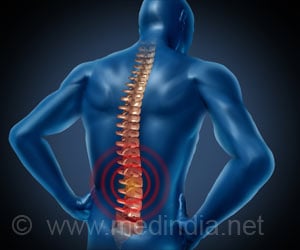
Fibrinogen, a blood-clotting protein found in circulating blood, has been found to inhibit the growth of central nervous system neuronal cells, a process that is necessary for the regeneration of the spinal cord after traumatic injury.
The findings by researchers at the University of California, San Diego (UCSD) School of Medicine, may explain why the human body is unable to repair itself after most spinal cord injuries.The study, led by Katerina Akassoglou, Ph.D., assistant professor in UCSD’s Department of Pharmacology, is the first evidence that when blood leaks into the nervous system, the blood protein contributes to the neurons’ inability to repair themselves.
The findings, which show the molecular link between vascular and neuronal damage during injury to the central nervous system, was published in the online issue of the Proceedings of the National Academy of Sciences on July 2.
The research team studied three types of spinal cord injuries in mice and rats which resulted in cellular and vascular damage, and leakage of fibrinogen from the blood vessels.
Once injured, neurons cannot be repaired because of various inhibitors that are present in the brain and the spinal cord after damage, which results in a patient’s paralysis. The researchers were surprised at the massive deposits of fibrinogen found at the sites of injury. That discovery led them to investigate the protein’s effect on neuronal cells’ ability to regenerate.
“Our study shows that fibrinogen directly affects neurons by inhibiting their ability for repair,” said Akassoglou. Fibrinogen – contained in the blood which leaks at the site of injury – begins the process of inhibiting axonal growth by binding to the beta 3 integrin receptor.
Advertisement
The discovery may open the door to a possible strategy to improving recovery after spinal cord injury by discovering a way to block activation of neuronal receptors by fibrinogen.
Advertisement
“Inhibiting the damaging effects of fibrinogen on neurons may potentially facilitate repair in the nervous system after injury” said Akassoglou.
A similar mechanism could be at work in other neurological diseases that result in paralysis, such as multiple sclerosis or hemorrhagic stroke, where blood vessels break and bleed into the brain. She added that such a therapeutic approach wouldn’t interfere with fibrinogen’s essential role in coagulation, because its blood-clotting mechanism depends on binding with a different receptor.
Source-Newswise
JAY/M