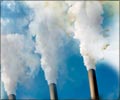
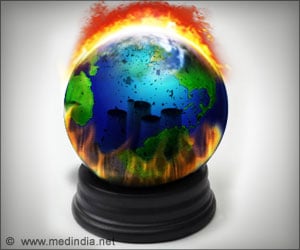
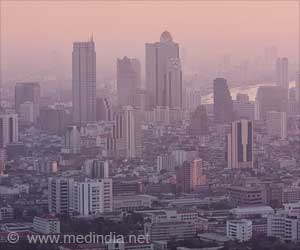
Air pollution in China is causing more diseases and claiming more lives. The pollution is costing China 3.8 percent of its gross domestic product, warns the World Bank.
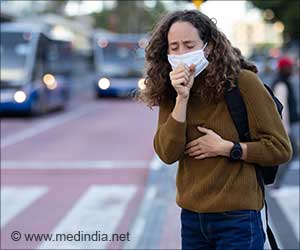
Air pollution is costing China 3.8 percent of its gross domestic product, causing more diseases and claiming more lives, the World Bank has warned. While it has put the combined health and non-health cost of outdoor air and water pollution for China's economy at around 100 billion dollars a year, or about 5.8 percent of the country's GDP, David Dollar, the World Bank country director for China and Mongolia, said air pollution poses higher costs than water pollution.Air pollution, especially in large cities, is leading to higher incidence of lung diseases, including cancer, respiratory system problems, and therefore, higher levels of work and school absenteeism, Dollar said, quoting a World Bank report issued following a joint assessment with China's State Environmental Protection Administration (SEPA), Xinhua reported.
He pointed to particulate matter, which measures less than 10 microns in diameter, as a major threat to health. The density of particulate matter in north China averages 112 microgrammes and that in the south, 88 microgrammes, he said at a forum on China's investment environment in Chengdu, capital of southwest China's Sichuan Province. Particulate matter has also been a headache in Beijing, with density averaging 141 microgrammes.
As part of the joint study, the World Bank and SEPA also conducted a survey in the southwestern Chongqing Municipality, one of the worst polluted Chinese regions, and the commercial center Shanghai, and found many citizens are willing to pay for reduced health risks associated with environmental pollution.
Dollar said it would be a cost-effective move to reduce air pollution by moving manufacturing plants out of city centres, replacing coal-burning stoves with liquefied gas-fuelled heating systems, increasing state investment in public transport and limiting use of private cars. Despite the pollution challenges, the World Bank affirmed China's commitment to address the problem.
China has put environment protection as its highest priority in its 11th Five Year Plan and called for a "resource saving society". China is set to improve its energy efficiency by cutting energy consumption by 20 percent per unit of GDP, along with a 10 percent cut in major pollutants, between 2006 and 2010.
Advertisement
LIN/P