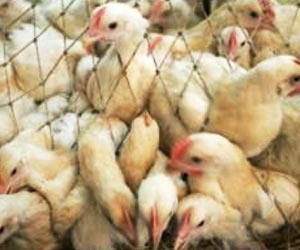
A new study has found that the bird flu virus can survive for up to two years in the carcasses of buried birds.
Dr. Shannon Bartelt-Hunt, an environmental engineer at the University of Nebraska-Lincoln, says that the findings of the study indicate that waste managers need to be particularly careful with how they dispose and manage landfills containing infected birds.
Avian Influenza / Bird Flu-Causes-Symptoms-Treatment- FAQs
Bird flu (avian influenza/avian flu) is a disease caused by an influenza virus (H5N1) that primarily affects birds but can infect humans also.
Bird flu (avian influenza/avian flu) is a disease caused by an influenza virus (H5N1) that primarily affects birds but can infect humans also.
Bird flu is an H5N1 form of the influenza virus that mainly infects birds, including chicken, ducks and turkeys.
Whenever any bird gets infected with the virus, farmers usually kill the entire flock to subdue an outbreak.

Human Nose Too Cold For Bird Flu Viruses To Thrive: Study
A study has revealed that avian influenza viruses do not thrive in humans because the temperature inside their noses is very low.
A study has revealed that avian influenza viruses do not thrive in humans because the temperature inside their noses is very low.
Even though there are options for disposal like composting and burning, most carcasses often end up in landfills.
Advertisement

Polish Health Workers on Trial for Bird Flu Vaccine Scam
Nine health workers went on trial in northern Poland Monday accused of having tested a vaccine against bird flu on nearly 200 patients without their knowledge, court officials said.
Nine health workers went on trial in northern Poland Monday accused of having tested a vaccine against bird flu on nearly 200 patients without their knowledge, court officials said.
The researchers then tested the mixtures at four different temperatures levels, three pH levels, and three levels of conductivity to test for the presence of heavy metals.
Advertisement

First Genetic Analysis Of Swine Flu Shows Its Potentiality
The first genetic analysis of the efficacy of swine flu virus H1N1 transmission from person to person revealed that it spreads barely well enough to keep itself going.
The first genetic analysis of the efficacy of swine flu virus H1N1 transmission from person to person revealed that it spreads barely well enough to keep itself going.
Reporting their findings in the journal Environmental Science and Technology, the researchers said that at colder temperatures and neutral pH levels, the virus was likely to survive the longest-sometimes for up to nearly two years.
"The assumption was that once it's in the landfill, there's no more question about whether it's infectious. This is suggestive that carcasses will likely remain infectious when they're placed in a landfill and for a period of time after that," says Bartelt-Hunt.
The new work suggests that the bodies should get covered quickly to raise their temperature, or to make the landfill more acidic or basic to deactivate the virus as quicly as possible.
"In general, waste disposal is one of those things that's just 'out of sight, out of mind'. Once it gets there, people tend to think it's just gone and they don't have to worry about it ... It's hard to say if waste disposal is this huge unknown red flag out there, but I think having some consistent guidelines is important," says Bartelt-Hunt.
Source-ANI
TAN