Computed Tomography Scan (CT Scan)
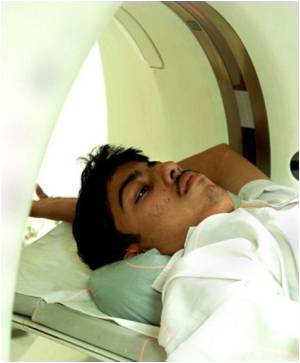
Computed Tomography (CT) scan is a type of medical examination that uses X-rays and computer processing to create sectional images of the body to provide more efficient results than X-rays.
Computed Tomography (CT) scan is a type of medical examination that uses X-rays and computer processing to create sectional images of the body to provide more efficient results than X-rays.
Based on recent advances in the field of compressed sensing, Jia and his colleagues developed an innovative CT reconstruction algorithm for graphic processing unit (GPU) platforms. The GPU processes data in parallel –-- increasing computational efficiency and making it possible to reconstruct a cone beam CT scan in about two minutes. (Modern GPU cards were originally designed to power 3D computer graphics, especially for video games.)
With only 20 to 40 total number of X-ray projections and 0.1 mAs per projection, the team achieved images clear enough for image-guided radiation therapy. The reconstruction time ranged from 77 to 130 seconds on an NVIDIA Tesla C1060 GPU card, depending on the number of projections –-- an estimated 100 times faster than similar iterative reconstruction approaches, says Jia.

CT Scans For Severe Asthma: Indian-Origin Scientist
An Indian-origin researcher is investigating the use of CT (Computed Tomography) scanning for patients suffering from severe asthma.
An Indian-origin researcher is investigating the use of CT (Computed Tomography) scanning for patients suffering from severe asthma.
"With our technique, we can reconstruct cone beam CT images with only a few projections -- 40 in most cases -- and lower mAs levels," he says. "This considerably lowered the radiation dose."
Advertisement

Research: CT Scans may Generate One Third More Radiation Than Needed
An Australian study has said that CT scans generate up to one third more radiation than needed to yield a clear diagnostic image, thus exposing patients to an increased risk of cancer.
An Australian study has said that CT scans generate up to one third more radiation than needed to yield a clear diagnostic image, thus exposing patients to an increased risk of cancer.
"In my mind, the most interesting and compelling possibilities of this technique are beyond cancer radiotherapy," says Steve Jiang, senior author of the study and a UCSD associate professor of radiation oncology.
Advertisement

CT Scans can Help Identify Emphysema Risk in Smokers
Researchers at the University of Iowa found that CT scans can help identify smokers at risk of emphysema.
Researchers at the University of Iowa found that CT scans can help identify smokers at risk of emphysema.
"Our work, when extended from cancer radiotherapy to general diagnostic imaging, may provide a unique solution to solve this problem by reducing the CT dose per scan by a factor of 10 or more," says Jiang.
Source-Eurekalert