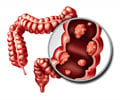
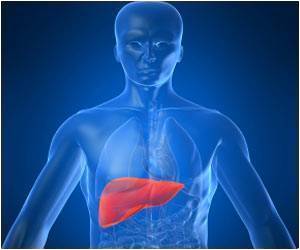
Scientist from the Weizmann Institute have unveil the actions of a key player in colorectal cancer. colorectal cancer is initiated by changes in a key protein – beta-cate This protein enter the cell nucleus and activate gene expression but in colorectal cancer beta-catenin over-accumulates in the cell and wrongly activates genes, leading to cancer. The tumor starts off as a polyp but then turns into an invasive and violent cancer, which often spreads to the liver. Today this is one of the most prevalent cancers the world. In an article recently published in the journal Cancer Research, Prof. Avri Ben-Ze’ev and Dr. Nancy Gavert of the Weizmann Institute’s Molecular Cell Biology Department reveal mechanisms that help this cancer metastasize.
Surprisingly, one of the genes activated by beta-catenin, which had been previously detected in colorectal cancer cells by Ben-Ze’ev’s group, codes for a receptor called L1-CAM. This receptor is a protein usually found on nerve cells, where it plays a role in nerve cell recognition and motility. What is this receptor doing in cancer cells" Ben-Ze’ev’s previous research had shown that L1-CAM is only expressed on certain cells located at the invasive front of the tumor tissue, hinting that it could be an important player in metastasis.In this study, the scientists found that colorectal cancer cells engineered to express the L1-CAM gene indeed spread to the liver, while those cells lacking L1-CAM did not.
In collaboration with Prof. Eytan Domany and research student Michal Sheffer of the Insitute’s Physics of Complex Systems Department, Ben-Ze’ev then compared the expression of genes induced by L1-CAM in cultured colon cancer cells to those in 170 samples of colorectal cancer tissue removed from patients, and in 40 samples of normal colon tissue. Out of some 160 genes induced by L1-CAM, about 60 were highly expressed in the cancerous tissue, but not in normal colon tissue. Ben-Ze’ev plans to conduct further research into the role of these genes, to uncover L1-CAM’s function in metastasis
Source-Eurekalert
BIN/C