The Nobel Prize in Medicine (2005 to 2009)
P
M
 Nobel Prize in Medicine 2005-2009
 The Nobel Prize is an International Award governed by the Nobel Foundation in Stockholm, Sweden. It consists of a medal, personal diploma, and a cash award.
First Noble Prize in Physiology or Medicine was awarded in 1901 to Emil von Behring for his work on serum therapy.
Since then The Nobel Prize in Medicine has highlighted a number of important discoveries like penicillin, genetic engineering and blood-typing. Find out more about the Nobel Laureates in Physiology or Medicine and their work from 2005 to 2009
The Nobel Prize is an International Award governed by the Nobel Foundation in Stockholm, Sweden. It consists of a medal, personal diploma, and a cash award.
First Noble Prize in Physiology or Medicine was awarded in 1901 to Emil von Behring for his work on serum therapy.
Since then The Nobel Prize in Medicine has highlighted a number of important discoveries like penicillin, genetic engineering and blood-typing. Find out more about the Nobel Laureates in Physiology or Medicine and their work from 2005 to 2009
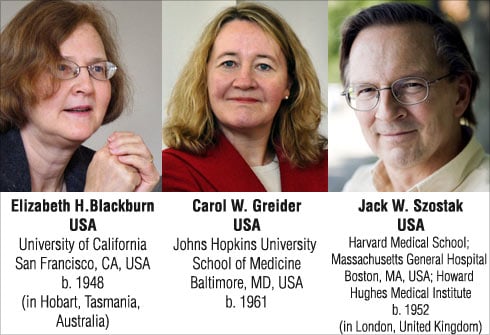 The Nobel Prize in Medicine 2009 "for the discovery of how chromosomes are protected by telomeres and the enzyme telomerase"
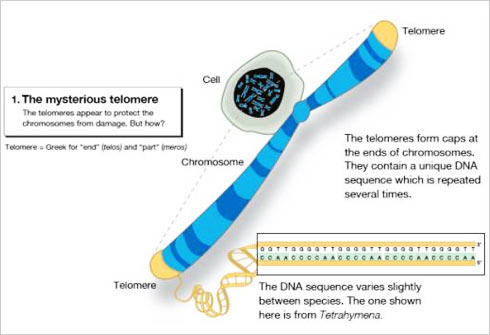 Earlier it was suspected that the telomeres could have a protective role,but how they operate remained an enigma.
Also When a cell is about to divide,the four bases of the DNA molecules that form the genetic code are copied base by DNA polymerase enzymes. However, for one of the two DNA strands, a problem exists in that the very end of the strand cannot be copied. Therefore, the chromosomes should be shortened every time a cell divides – but in fact that is not usually the case .
Both these problems were solved when this year's Nobel Laureates discovered how the telomere functions and found the enzyme that copies it.
Earlier it was suspected that the telomeres could have a protective role,but how they operate remained an enigma.
Also When a cell is about to divide,the four bases of the DNA molecules that form the genetic code are copied base by DNA polymerase enzymes. However, for one of the two DNA strands, a problem exists in that the very end of the strand cannot be copied. Therefore, the chromosomes should be shortened every time a cell divides – but in fact that is not usually the case .
Both these problems were solved when this year's Nobel Laureates discovered how the telomere functions and found the enzyme that copies it.
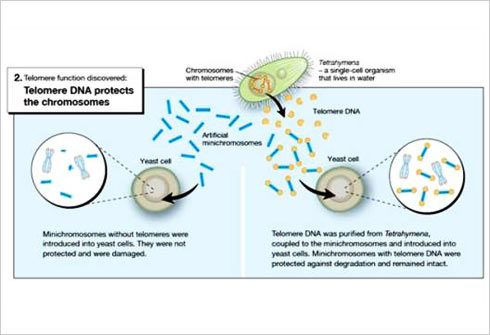 When studying the chromosomes of Tetrahymena, a unicellular ciliate organism, Elizabeth Blackburn identified a DNA sequence that was repeated several times at the ends of the chromosomes. The function of this sequence, CCCCAA, was unclear. At the same time, Jack Szostak had made the observation that a linear DNA molecule, a type of minichromosome, is rapidly degraded when introduced into yeast cells.
Both of them decided to perform an experiment.From the DNA of Tetrahymena, Blackburn isolated the CCCCAA sequence. Szostak coupled it to the minichromosomes and put them back into yeast cells. The results were striking – the telomere DNA sequence protected the minichromosomes from degradation.
As telomere DNA from one organism, Tetrahymena, protected chromosomes in an entirely different one, yeast, this demonstrated the existence of a previously unrecognized fundamental mechanism.
When studying the chromosomes of Tetrahymena, a unicellular ciliate organism, Elizabeth Blackburn identified a DNA sequence that was repeated several times at the ends of the chromosomes. The function of this sequence, CCCCAA, was unclear. At the same time, Jack Szostak had made the observation that a linear DNA molecule, a type of minichromosome, is rapidly degraded when introduced into yeast cells.
Both of them decided to perform an experiment.From the DNA of Tetrahymena, Blackburn isolated the CCCCAA sequence. Szostak coupled it to the minichromosomes and put them back into yeast cells. The results were striking – the telomere DNA sequence protected the minichromosomes from degradation.
As telomere DNA from one organism, Tetrahymena, protected chromosomes in an entirely different one, yeast, this demonstrated the existence of a previously unrecognized fundamental mechanism.
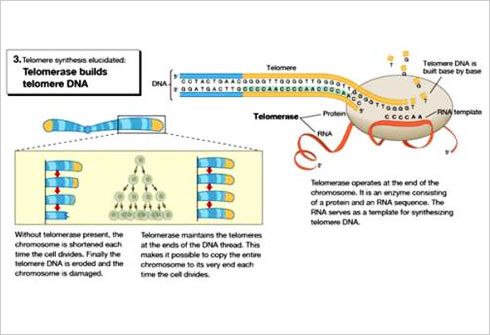 In 1984, Carol Greider discovered signs of enzymatic activity in a cell extract. Greider and Blackburn named the enzyme telomerase and showed that it consists of RNA as well as protein.
The RNA component turned out to contain the CCCCAA sequence. It serves as the template when the telomere is built, while the protein component is required for the construction work, i.e. the enzymatic activity. Telomerase extends telomere DNA that enables DNA polymerases to copy the entire length of the chromosome.
In 1984, Carol Greider discovered signs of enzymatic activity in a cell extract. Greider and Blackburn named the enzyme telomerase and showed that it consists of RNA as well as protein.
The RNA component turned out to contain the CCCCAA sequence. It serves as the template when the telomere is built, while the protein component is required for the construction work, i.e. the enzymatic activity. Telomerase extends telomere DNA that enables DNA polymerases to copy the entire length of the chromosome.
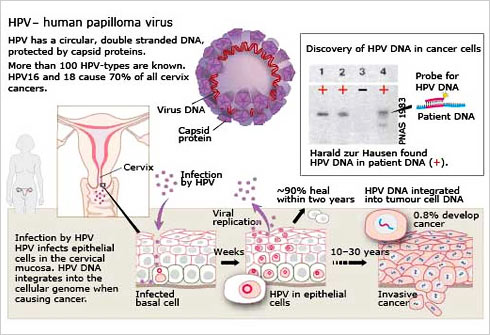
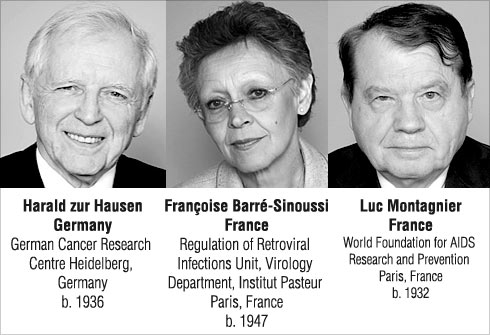 The Nobel Prize in Medicine 2008Harald zur Hausen - "for his discovery of human papilloma viruses causing cervical cancer"
Françoise Barré-Sinoussi & Luc Montagnier - "for their discovery of human immunodeficiency virus"
The Nobel Prize in Medicine 2008Harald zur Hausen - "for his discovery of human papilloma viruses causing cervical cancer"
Françoise Barré-Sinoussi & Luc Montagnier - "for their discovery of human immunodeficiency virus"
 Françoise Barré-Sinoussi and Luc Montagnier discovered human immunodeficiency virus (HIV). Virus production was identified in lymphocytes from patients with enlarged lymph nodes in early stages of acquired immunodeficiency, and in blood from patients with late stage disease. They characterized this retrovirus as the first known human lentivirus based on its morphological, biochemical and immunological properties. HIV impaired the immune system because of massive virus replication and cell damage to lymphocytes. The discovery was one prerequisite for the current understanding of the biology of the disease and its antiretroviral treatment.
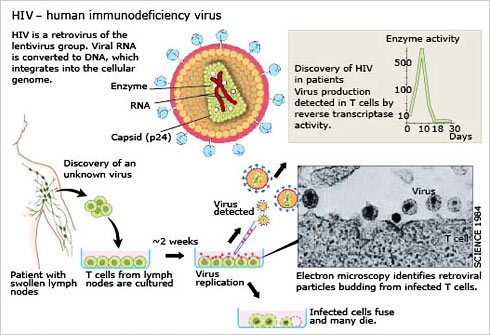 Françoise Barré-Sinoussi and Luc Montagnier isolated and cultured lymph node cells from patients that had swollen lymph nodes characteristic of the early stage of acquired immune deficiency. They detected activity of the retroviral enzyme reverse transcriptase, a direct sign of retrovirus replication. They also found retroviral particles budding from the infected cells.
Isolated virus infected and killed lymphocytes from both diseased and healthy donors, and reacted with antibodies from infected patients.
In contrast to previously characterized human oncogenic retroviruses, the novel retrovirus they had discovered, now known as human immunodeficiency virus (HIV), did not induce uncontrolled cell growth. Instead, the virus required cell activation for replication and mediated cell fusion of T lymphocytes. This partly explained how HIV impairs the immune system since the T cells are essential for immune defence.
Françoise Barré-Sinoussi and Luc Montagnier isolated and cultured lymph node cells from patients that had swollen lymph nodes characteristic of the early stage of acquired immune deficiency. They detected activity of the retroviral enzyme reverse transcriptase, a direct sign of retrovirus replication. They also found retroviral particles budding from the infected cells.
Isolated virus infected and killed lymphocytes from both diseased and healthy donors, and reacted with antibodies from infected patients.
In contrast to previously characterized human oncogenic retroviruses, the novel retrovirus they had discovered, now known as human immunodeficiency virus (HIV), did not induce uncontrolled cell growth. Instead, the virus required cell activation for replication and mediated cell fusion of T lymphocytes. This partly explained how HIV impairs the immune system since the T cells are essential for immune defence.
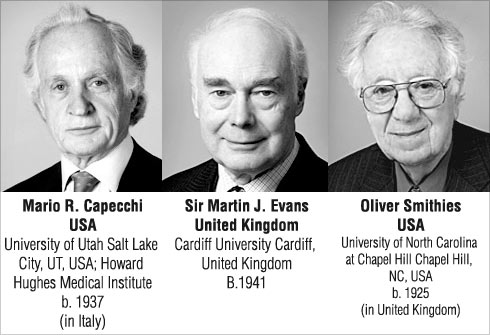 The Nobel Prize in Medicine 2007"for their discoveries of principles for introducing specific gene modifications in mice by the use of embryonic stem cells"
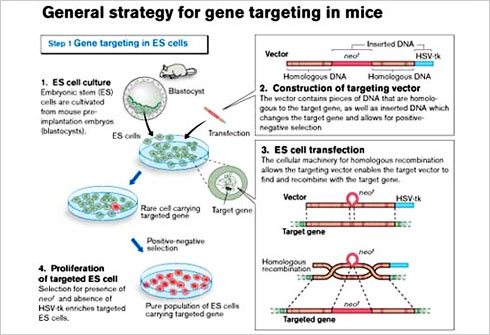 Our DNA is packaged in chromosomes, which occur in pairs – one inherited from the father and one from the mother. Exchange of DNA sequences within such chromosome pairs increases genetic variation in the population and occurs by a process called homologous recombination.
Smithies discovered that endogenous genes could be targeted irrespective of their activity which suggested that all genes may be accessible to modification by homologous recombination.
Capecchi demonstrated that homologous recombination could take place between introduced DNA and the chromosomes in mammalian cells. He showed that defective genes could be repaired by homologous recombination with the incoming DNA.
Martin Evans had the vision to use EC cells as vehicles to introduce genetic material into the mouse germ line.Evans discovered that chromosomally normal cell cultures could be established directly from early mouse embryos. These cells are now referred to as embryonic stem (ES) cells.
Our DNA is packaged in chromosomes, which occur in pairs – one inherited from the father and one from the mother. Exchange of DNA sequences within such chromosome pairs increases genetic variation in the population and occurs by a process called homologous recombination.
Smithies discovered that endogenous genes could be targeted irrespective of their activity which suggested that all genes may be accessible to modification by homologous recombination.
Capecchi demonstrated that homologous recombination could take place between introduced DNA and the chromosomes in mammalian cells. He showed that defective genes could be repaired by homologous recombination with the incoming DNA.
Martin Evans had the vision to use EC cells as vehicles to introduce genetic material into the mouse germ line.Evans discovered that chromosomally normal cell cultures could be established directly from early mouse embryos. These cells are now referred to as embryonic stem (ES) cells.
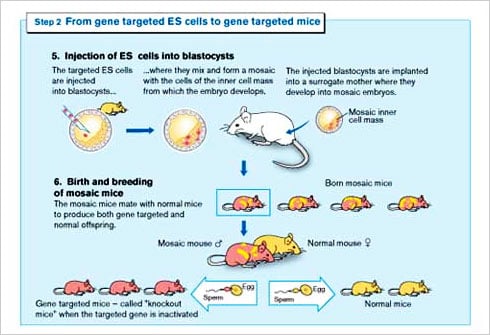 The next step was to show that ES cells could contribute to the germ line.Embryos from one mouse strain were injected with ES cells from another mouse strain. These mosaic embryos (i.e. composed of cells from both strains) were then carried to term by surrogate mothers. The mosaic offspring was subsequently mated, and the presence of ES cell-derived genes detected in the pups. These genes would now be inherited according to Mendel’s laws.
Evans now began to modify the ES cells genetically and for this purpose chose retroviruses, which integrate their genes into the chromosomes. He demonstrated transfer of such retroviral DNA from ES cells, through mosaic mice, into the mouse germ line. Evans had used the ES cells to generate mice that carried new genetic material.
Capecchi refined the strategies for targeting genes and developed a new method (positive-negative selection) that could be generally applied.
Gene targeting has helped us understand the roles of many hundreds of genes in mammalian fetal development. Capecchis work has shed light on the causes of several human inborn malformations.Evans applied gene targeting to develop mouse models for human diseases.Smithies also used gene targeting to develop mouse models for inherited diseases such as cystic fibrosis and the blood disease thalassemia. He has also developed numerous mouse models for common human diseases such as hypertension and atherosclerosis.
The next step was to show that ES cells could contribute to the germ line.Embryos from one mouse strain were injected with ES cells from another mouse strain. These mosaic embryos (i.e. composed of cells from both strains) were then carried to term by surrogate mothers. The mosaic offspring was subsequently mated, and the presence of ES cell-derived genes detected in the pups. These genes would now be inherited according to Mendel’s laws.
Evans now began to modify the ES cells genetically and for this purpose chose retroviruses, which integrate their genes into the chromosomes. He demonstrated transfer of such retroviral DNA from ES cells, through mosaic mice, into the mouse germ line. Evans had used the ES cells to generate mice that carried new genetic material.
Capecchi refined the strategies for targeting genes and developed a new method (positive-negative selection) that could be generally applied.
Gene targeting has helped us understand the roles of many hundreds of genes in mammalian fetal development. Capecchis work has shed light on the causes of several human inborn malformations.Evans applied gene targeting to develop mouse models for human diseases.Smithies also used gene targeting to develop mouse models for inherited diseases such as cystic fibrosis and the blood disease thalassemia. He has also developed numerous mouse models for common human diseases such as hypertension and atherosclerosis.
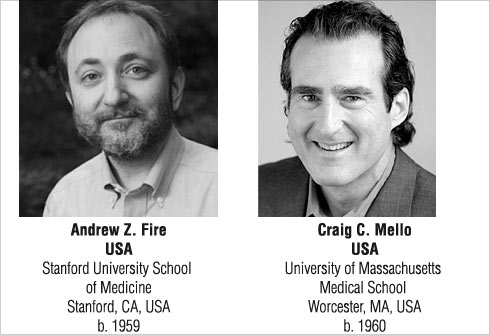 The Nobel Prize in Medicine 2006"for their discovery of RNA interference - gene silencing by double-stranded RNA"
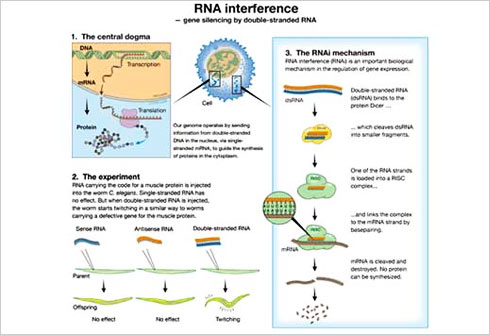 Nobel Prize in Medicine 2005-2009Andrew Z. Fire and Craig C. Mello discovered a fundamental mechanism for controlling the flow of genetic information. Our genome operates by sending instructions for the manufacture of proteins from DNA in the nucleus of the cell to the protein synthesizing machinery in the cytoplasm. These instructions are conveyed by messenger RNA (mRNA).
In 1998, these scientists published their discovery of a mechanism that can degrade mRNA from a specific gene. This mechanism, RNA interference, is activated when RNA molecules occur as double-stranded pairs in the cell. Double-stranded RNA activates biochemical machinery which degrades those mRNA molecules that carry a genetic code identical to that of the double-stranded RNA. When such mRNA molecules disappear, the corresponding gene is silenced and no protein of the encoded type is made.
Nobel Prize in Medicine 2005-2009Andrew Z. Fire and Craig C. Mello discovered a fundamental mechanism for controlling the flow of genetic information. Our genome operates by sending instructions for the manufacture of proteins from DNA in the nucleus of the cell to the protein synthesizing machinery in the cytoplasm. These instructions are conveyed by messenger RNA (mRNA).
In 1998, these scientists published their discovery of a mechanism that can degrade mRNA from a specific gene. This mechanism, RNA interference, is activated when RNA molecules occur as double-stranded pairs in the cell. Double-stranded RNA activates biochemical machinery which degrades those mRNA molecules that carry a genetic code identical to that of the double-stranded RNA. When such mRNA molecules disappear, the corresponding gene is silenced and no protein of the encoded type is made.
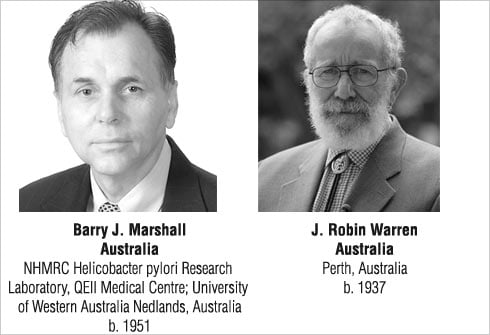 The Nobel Prize in Medicine 2005"for their discovery of the bacterium Helicobacter pylori and its role in gastritis and peptic ulcer disease"
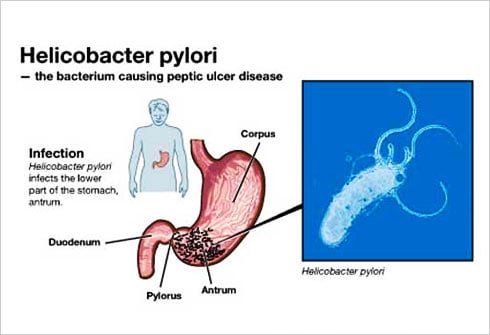 Helicobacter pylori causes life-long infectionHelicobacter pylori is a spiral-shaped Gram-negative bacterium that colonizes the stomach in about 50% of all humans.
Infection is typically contracted in early childhood, frequently by transmission from mother to child, and the bacteria may remain in the stomach for the rest of the person's life. This chronic infection is initiated in the lower part of the stomach (antrum).
Robin Warren reported that the presence of Helicobacter pylori is always associated with an inflammation of the underlying gastric mucosa as evidenced by an infiltration of inflammatory cells.
Helicobacter pylori causes life-long infectionHelicobacter pylori is a spiral-shaped Gram-negative bacterium that colonizes the stomach in about 50% of all humans.
Infection is typically contracted in early childhood, frequently by transmission from mother to child, and the bacteria may remain in the stomach for the rest of the person's life. This chronic infection is initiated in the lower part of the stomach (antrum).
Robin Warren reported that the presence of Helicobacter pylori is always associated with an inflammation of the underlying gastric mucosa as evidenced by an infiltration of inflammatory cells.
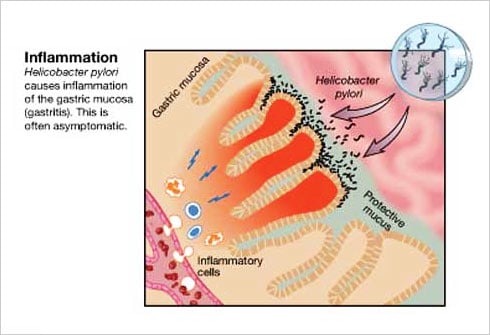 The bacterium itself is extremely variable, and strains differ markedly in many aspects, such as adherence to the gastric mucosa and ability to provoke inflammation. Even in a single infected individual all bacteria are not identical, and during the course of chronic infection bacteria adapt to the changing conditions in the stomach with time.
The current view is that the chronic inflammation in the distal part of the stomach caused by Helicobacter pylori infection results in an increased acid production from the non-infected upper corpus region of the stomach. This will predispose for ulcer development in the more vulnerable duodenum.
The bacterium itself is extremely variable, and strains differ markedly in many aspects, such as adherence to the gastric mucosa and ability to provoke inflammation. Even in a single infected individual all bacteria are not identical, and during the course of chronic infection bacteria adapt to the changing conditions in the stomach with time.
The current view is that the chronic inflammation in the distal part of the stomach caused by Helicobacter pylori infection results in an increased acid production from the non-infected upper corpus region of the stomach. This will predispose for ulcer development in the more vulnerable duodenum.
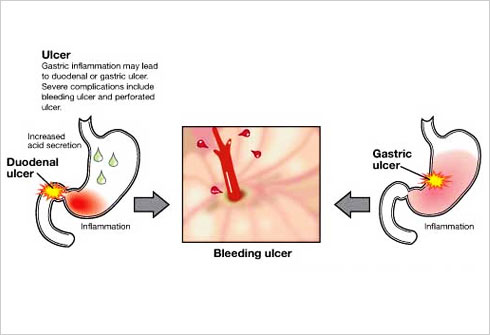 The severity of this inflammation and its location in the stomach is of crucial importance for the diseases that can result from Helicobacter pylori infection. In most individuals Helicobacter pylori infection is asymptomatic. However, about 10-15% of infected individuals will some time experience peptic ulcer disease. Such ulcers are more common in the duodenum than in the stomach itself. Severe complications include bleeding and perforation.
Latest Nobel Prize News
More News >>
- Video Animation
- Slideshows
- Videos
- Infographics
-
 Angioplasty
-
 Cardiopulmonary Resuscitation
-
 Heart Attack
-
 Coronary Artery Bypass Surgery
-
 Mitral Valve Disease and Replacement
-
 Atrial Septal Defect
-
 Ventricular Septal Defect
-
 Active Heart
-
 Patent Ductus Arteriosus
-
 Blood Pressure
-
 Learn How to Count Your Pulse
-
 Angioplasty - 3D
-
 How to know if someone is Breathing
-
 Healthy Foods for People with Kidney Disease
-
 Antioxidant Rich Spices
-
 Foods to Increase Height
-
 Control Blood Sugar in 7 Ways
-
 Eight Ways to Stay Hydrated Besides Water
-
 Your Nails Can Say A lot About Your Health
-
 Foods That Stain your Teeth
-
 Type 2 Diabetes
-
 Insulin Injections for Diabetes
-
 Alcohol - Benefits and Harms